


Table of Contents
Seven in the morning, eastbound I-40 where the lanes climb into the Big I stack. A loaded semi two lanes over starts drifting, the trailer first, the way they do. Concrete barrier on your left, a pickup on your right, and roughly two seconds to pick an option that does not exist.
If a moment like that put you or someone you love in a hospital, understand this early: a truck crash in Albuquerque is not a car accident with a bigger vehicle. It is a different kind of case, governed by federal safety rules, defended by companies that put investigators on the scene within hours, and built on evidence that starts disappearing in days. Handled properly, it is also a case where full compensation is realistic, because commercial insurance policies are many times larger than personal ones.
Why does so much freight run through Albuquerque?
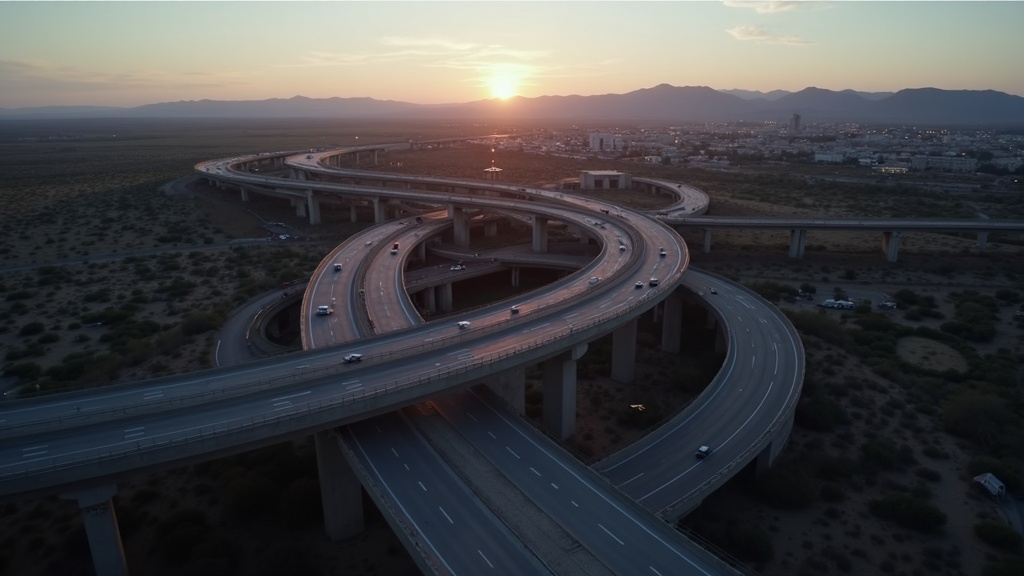
Geography made this city a freight crossroads. I-40 is one of the country’s main east-west corridors, carrying goods from the West Coast ports toward the middle and eastern states, and I-25 is the north-south spine of the mountain region. They meet at the Big I, rebuilt between 2000 and 2002 into a five-level stack designed to carry roughly 400,000 vehicles a day, the busiest interchange in New Mexico.
A large share of the trucks in that flow are through-freight: rigs that never stop in Albuquerque, driven by people who have been on the road since another state and will sleep in a third. Add short merge distances, the climb over Nine Mile Hill on the west side, sun glare on the east-west runs, and the everyday speed difference between a commuter late for work and eighty thousand pounds of loaded trailer, and you have the crash pattern local emergency rooms know well. We compare the two case types in detail in our guide to truck accidents versus car accidents in New Mexico.
Which federal rules was the driver supposed to follow?
Commercial carriers and their drivers operate under the Federal Motor Carrier Safety Administration’s regulations, and those rules become the measuring stick for negligence in a truck case. The hours-of-service rules cap driving at 11 hours inside a 14-hour on-duty window, followed by at least 10 consecutive hours off. Electronic logging devices record driving time automatically. Carriers must run drug and alcohol testing programs, keep vehicle inspection and maintenance records, and maintain qualification files showing each driver was licensed, medically certified and competent to be behind that wheel.
Every one of those requirements creates a paper trail, and every violation found in that trail strengthens the injured person’s case. A driver over his hours, a brake defect noted three inspections in a row and never repaired, a carrier that skipped a required test: these are not details, they are the case.
Who ends up as a defendant in a truck case?
In a two-car crash there is usually one driver and one insurer on the other side. In a truck case, the roster grows quickly:
- The driver, for the driving itself.
- The motor carrier, both for its driver’s conduct and for its own hiring, training and supervision decisions.
- The owner of the tractor or trailer, when it is a different company.
- The maintenance contractor, if a mechanical failure played a part.
- The shipper or loader, when badly loaded or unsecured cargo contributed.
Each of those parties has its own insurer and its own lawyers, and their favorite strategy is pointing at each other while your medical bills age. Sorting out who owed what duty is real work, but it has a practical upside: more responsible parties usually means more available coverage for a serious injury.
Why do lawyers send preservation letters within days?
Because the trucking company’s side starts working immediately. Major carriers have rapid-response teams, investigators and defense counsel who can be at a crash scene before the vehicles are towed. While you are in the emergency room, photographs are being taken and statements are being shaped on the other side.
Meanwhile, the most valuable evidence has a short shelf life. Federal rules require carriers to retain hours-of-service records for only about six months. Dashcam footage gets overwritten. Engine control module data can vanish when a tractor is repaired, salvaged or put back in service. A preservation letter, sometimes called a spoliation letter, formally notifies the carrier to keep all of it: the logs, the ELD data, the camera footage, the maintenance file, the driver’s file. Once that letter lands, destroying evidence carries legal consequences. Sending it late is the single most expensive mistake in these cases, which is why we treat it as a first-week task, not a someday task. You can find more on building an injury case in our New Mexico personal injury legal resources.
If your crash happened at the Big I, on the interstates, or anywhere in the metro, our Albuquerque accident team handles the investigation from the first call. The name on the door makes people grin; the preservation letters we send out do not.
Frequently asked questions
How much insurance coverage does a commercial truck carry?
Federal rules require most interstate freight carriers to carry at least $750,000 in liability coverage, and many carry one million dollars or more, sometimes with additional layers above that. That money exists, but it is defended hard. The size of the policy is exactly why carriers fight these claims more aggressively than a private driver’s insurer would.
What should I do if the trucking company’s insurer calls me?
Take down the caller’s name and company, then politely end the conversation. Do not give a recorded statement, do not guess about your injuries, and do not sign anything, especially medical releases or quick settlement offers. Early calls are designed to lock in your words before you know your diagnosis. Refer them to your lawyer once you have one.
Is the trucking company still responsible if the driver was an independent contractor?
Labels matter less than facts. When a truck is operating under a carrier’s federal operating authority, hauling its load, the carrier generally cannot escape responsibility by pointing to a contractor agreement. Courts look at whose authority, whose freight and whose control were involved. This is a common defense tactic, and a well-built case anticipates it.
What if I was partly at fault for the crash?
New Mexico follows pure comparative negligence, adopted by the state Supreme Court in Scott v. Rizzo in 1981. Your compensation is reduced by your percentage of fault but never eliminated entirely. Expect the truck’s insurer to push fault toward you; that is standard playbook, and it is answered with evidence, not accepted at face value.
If a commercial truck crash injured you or a family member in Albuquerque, call us today at (505) 207-5000. The case review is free, in English or Spanish, and there is no fee unless we win.
Free Case Review
Tell us what happened. There is no obligation to move forward.