


Table of Contents
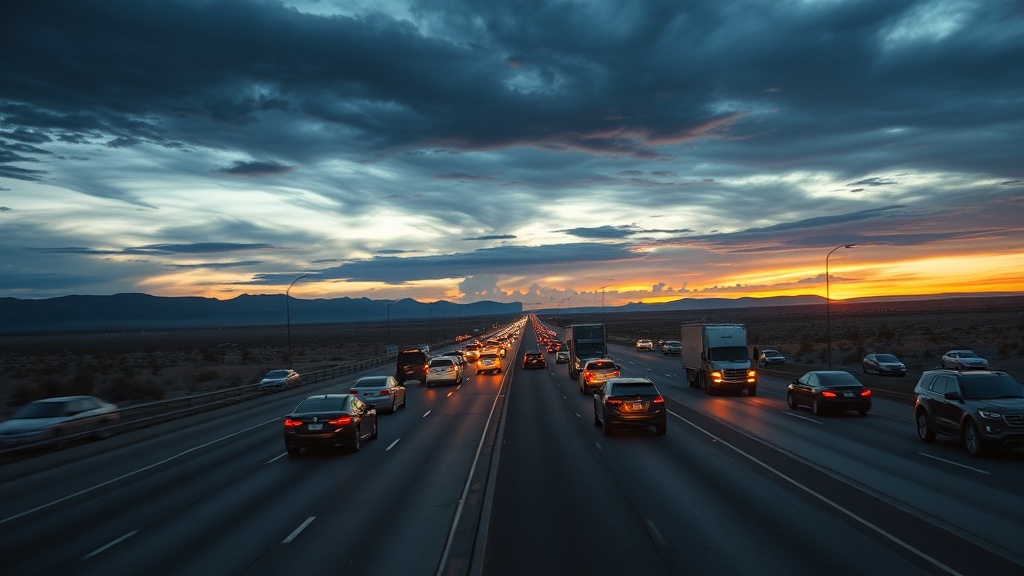
If you’ve ever driven I-40 west between Albuquerque and Gallup, you’ve sat in a standstill. Often it’s a commercial truck crash. Sometimes it’s debris from a previous crash. Sometimes it’s just construction.
The drivers who end up in our office aren’t usually the ones in the original crash. They’re the ones who were stopped in the line of stopped traffic — and got rear-ended by someone who wasn’t paying attention.
Here’s how New Mexico law handles secondary collision cases on the interstate.
What «secondary collision» means in NM personal injury law
A secondary collision is one that happens as a downstream consequence of a primary crash. Examples:
- You’re stopped in slow traffic backed up from a truck crash 2 miles ahead. The driver behind you wasn’t watching, and rear-ends you at 45 mph.
- A jackknife crash blocks both lanes. As traffic stops suddenly, a 5-car pileup forms.
- You stop on the shoulder to help. Another vehicle drifts onto the shoulder and hits you.
In each, the at-fault party is usually the rear-ending or trailing driver — not the original crash. But sometimes the original at-fault party (especially if it’s a commercial trucker with FMCSA violations) can also be liable.
The 3 potential defendants in a typical I-40 standstill case
1. The driver who rear-ended you
Under NMSA § 66-7-318, drivers are required to maintain a safe following distance and adequate stopping distance for road conditions. Rear-ending a stopped vehicle is presumptive negligence in NM. Their liability insurance is the first layer.
2. The original at-fault driver (if commercial)
If the primary crash that caused the backup was a commercial truck (semi, box truck, delivery vehicle), and that truck’s driver violated federal hours-of-service rules (FMCSA Part 395) or other federal motor carrier regulations, the trucking company itself can be liable for the foreseeable consequences — including secondary collisions in the backup that followed.
This isn’t a stretch. Federal courts have repeatedly held that when a fatigued or otherwise-impaired commercial driver causes a freeway crash, the trucking company knew or should have known that backups would form, and that secondary collisions would result. Liability flows.
3. NMDOT or contractor (in construction zone scenarios)
If poor signage, missing flaggers, or improperly marked construction zones contributed to the standstill, NMDOT or the road construction contractor may share liability under NMSA Chapter 41 (NM Tort Claims Act). Special 90-day notice rules apply — see below.
Critical: The 90-day notice rule for government claims
If any government entity is potentially involved (NMDOT, a state contractor, a sheriff vehicle, etc.), NMSA § 41-4-16 requires written notice of claim within 90 days of the incident. Miss the deadline, lose the right to pursue that defendant — even if you’d otherwise have 3 years to file suit under the general statute of limitations (NMSA § 37-1-8).
This is the trap that catches unrepresented people most often. The clock starts on the date of incident, not the date you learn there’s a potential government claim.
Why the I-40 corridor specifically is complex
The I-40 corridor between Albuquerque and Gallup passes through Navajo Nation land for approximately 150 miles. This creates jurisdictional questions:
- If a crash happens on Navajo Nation land, tribal court may have jurisdiction over certain parties (especially tribal members)
- Federal court may have jurisdiction if there’s diversity of citizenship (parties from different states) or a federal question
- NM state court has jurisdiction in most state-resident cases
The right court determines applicable procedural rules, available damages, jury composition, and statute of limitations. Choosing the wrong forum can extinguish the claim entirely.
What to do immediately if you were hit in a secondary collision
- Call 911 if anyone is injured or if vehicles are blocking traffic. A NM State Police report on I-40 is essential evidence.
- Take photos of every vehicle involved, the road conditions, signage, weather, and the backup that caused the standstill. Photos showing why traffic was stopped matter for liability.
- Get the names and contact info of witnesses. Other drivers in the standstill saw what happened.
- Get medical attention immediately. Even if you feel fine, concussions and soft-tissue injuries often emerge 24-72 hours later.
- Do not give a recorded statement to any insurance company. Not the other driver’s, not yours, not the trucking company’s. Wait until you have counsel.
- Identify whether the primary crash involved a commercial vehicle. News reports, social media (r/NewMexico often posts within minutes), state police reports.
NM coverage that matters in these cases
Your own coverage often becomes critical because secondary-collision drivers in NM are frequently underinsured. Layers to evaluate:
- UM/UIM — NM allows stacking across multiple vehicles on the same policy. If you have 3 cars with $25K UM each, you may have $75K available when the at-fault driver is uninsured or underinsured.
- Med pay — Pays your medical bills regardless of fault, immediately. Doesn’t wait for liability determination.
- Personal injury protection (PIP) — Less common in NM but worth checking your declarations page.
The economic reality of these cases
Medical bills add up fast — ER visit ($2,000-$8,000), imaging ($1,000-$3,000), follow-up care, physical therapy, sometimes surgery. Lost wages from time off work. Pain and suffering. Future medical needs if symptoms persist.
The at-fault driver’s minimum NM policy is $25,000 per person — easily exhausted. The trucking company’s policy (if commercial vehicle involved upstream) typically carries $750K to $1M minimum federal requirements. Your own UM/UIM stack. Med pay. PIP if applicable.
A properly mapped coverage stack often reveals 3-5x the funds available compared to the initial at-fault driver’s minimum policy.
Frequently asked questions
Q: I wasn’t injured but my car is totaled. Do I have a case?
Property damage only is usually handled directly with the at-fault driver’s insurer — typically settles in 2-3 weeks. No attorney needed for property-damage-only cases below total loss thresholds.
Q: The driver who hit me said «I’m sorry, I wasn’t paying attention.» Does that admission help?
Yes, document it. Roadside admissions are admissible in NM. Write down their exact words, identify any witnesses to the statement.
Q: I gave a recorded statement to the other driver’s insurance. Did I ruin my case?
Not necessarily, but get counsel immediately. Recorded statements get used to dispute symptoms and timing later. The faster you have representation, the less leverage they have.
Q: How long do these cases take to resolve?
Soft-tissue with clear liability: 4-8 months. Surgery or complex liability (commercial defendant, tribal jurisdiction): 12-24 months.
Q: What if I was partly at fault for following too closely myself?
NM applies comparative negligence. Your damages are reduced by your fault percentage. You can still recover. Don’t disqualify yourself before consulting an attorney.
This is general information about New Mexico personal injury law and secondary collisions, not legal advice for your specific situation. Free, most of our team speaks spanish case evaluations are available at El Gringo Law.