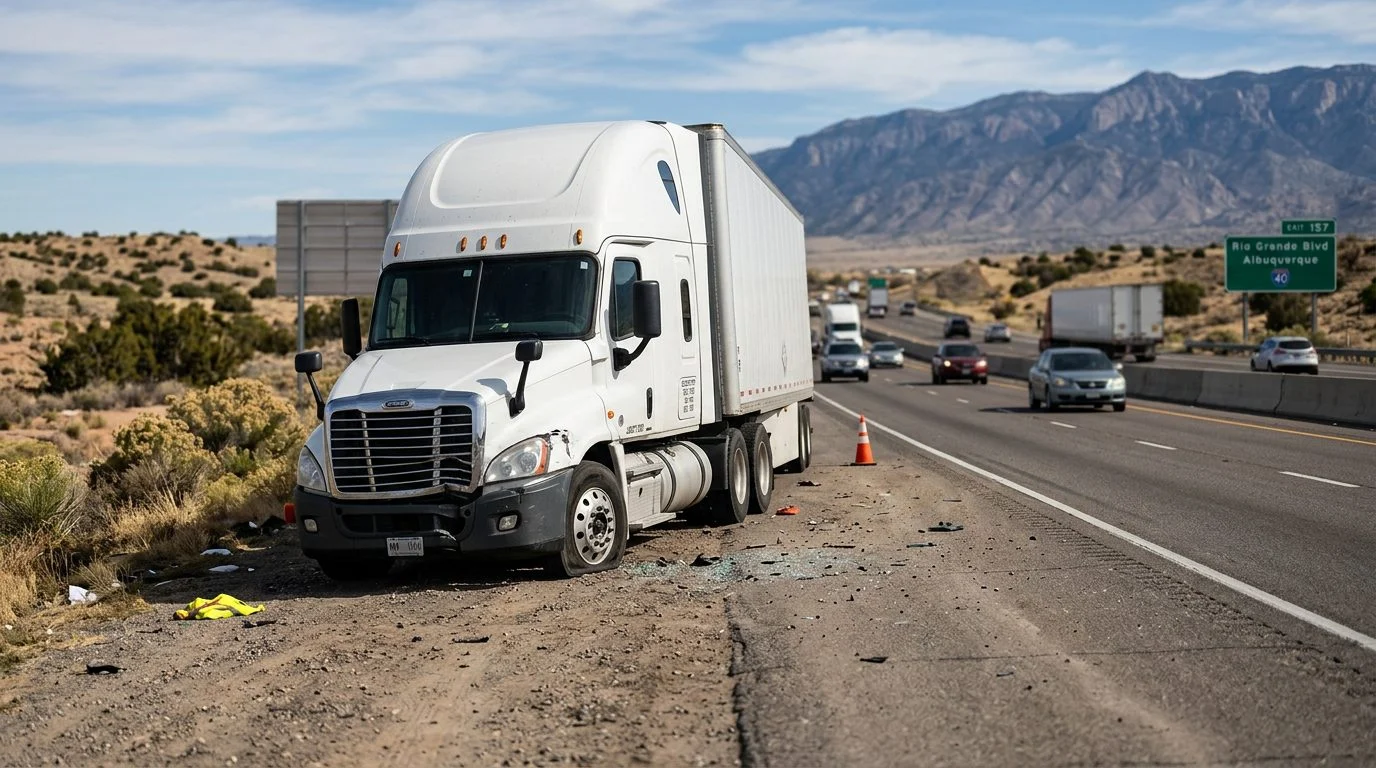
Albuquerque · Commercial Truck Crashes
Was the Truck Driver Past Federal Hour Limits?
When a commercial truck driver has been on the road longer than federal hours-of-service rules allow, the logs and records can matter. El Gringo Law focuses on truck crash cases in New Mexico. Your first consultation is free, confidential, and comes with no obligation to continue.
By Josh Wood · Published November 2, 2026
If you’re looking for a truck driver hours of service crash lawyer in Albuquerque, the core question is simple. Did the driver follow federal limits on driving and rest? Those limits can matter a great deal to a crash claim, and the driver’s own records often show whether they were followed. This page explains the rules, the proof, and New Mexico deadlines, whether you were hurt or you’re researching for someone you love.
What a Trucking Hours-of-Service Violation Is and Who It Affects
An hours-of-service violation happens when a commercial truck driver drives or works beyond federal limits on driving time and rest. Under 49 C.F.R. § 395.1, the rules in this part of the federal hours-of-service regulations apply to all motor carriers and drivers, except as provided in paragraphs (b) through (x) of that section. Separately, 49 C.F.R. § 392.3 bars a driver from operating a truck when fatigue makes it unsafe to keep going.
Fatigue is a safety concern on every kind of road.
This page is written for an injured driver or passenger, a pedestrian, or a family member of someone killed or badly hurt in a crash with a commercial truck. Many readers are researching while medical care and paperwork pile up. You don’t need every answer today.
If a truck crash has left someone you love facing injuries and hard questions, you don't have to sort through the logs and deadlines alone. Our team can talk it through with you. Talk it through with our team — the first consultation is free, confidential, and carries no obligation.
Federal Hours-of-Service Limits Truck Drivers Must Follow
Under 49 C.F.R. § 395.1, the rules in this part apply to all motor carriers and drivers, except as provided in paragraphs (b) through (x) of that section. Except as otherwise provided in § 395.1, including the State of Alaska exception in § 395.1(h), 49 C.F.R. § 395.3 bars a motor carrier from permitting or requiring a driver to drive a property-carrying commercial motor vehicle, and bars the driver from driving one, unless the driver complies with these requirements:
- Under 49 C.F.R. § 395.1, a driver may accumulate the equivalent of at least 10 consecutive hours off-duty by taking not more than two periods of either sleeper berth time or a combination of off-duty time and sleeper berth time if the conditions in that section are met.
- 11 hours of driving. Under 49 C.F.R. § 395.3, a driver may drive a total of 11 hours during the period specified in paragraph (a)(2), which is the period of 14 consecutive hours after coming on-duty following 10 consecutive hours off-duty.
- 14-hour window. A driver may not drive after 14 consecutive hours from coming on duty.
- 30-minute break. Except for drivers who qualify for either of the short-haul exceptions in § 395.1(e)(1) or (2), driving is not permitted once more than 8 hours of driving time pass without a consecutive 30-minute break.
- Weekly limits. Under 49 C.F.R. § 395.3, a driver of a property-carrying commercial motor vehicle may not drive after having been on duty 60 hours in any period of 7 consecutive days if the employing motor carrier does not operate commercial motor vehicles every day of the week. The same section bars driving after having been on duty 70 hours in any period of 8 consecutive days if the employing motor carrier operates commercial motor vehicles every day of the week. An off-duty period of 34 or more consecutive hours can restart the count.
The rule begins with “except as otherwise provided,” so exceptions exist. Which limits apply depends on the facts of the trip and the carrier.
How an Hours-of-Service Violation Is Proven After an Albuquerque Crash
The main proof is the driver’s electronic log, checked against company records. Most carriers must install and require electronic logging devices (ELDs) to record duty status, under 49 C.F.R. § 395.8. Paper logs are allowed only in the limited cases that rule lists.
Supporting documents matter too.
Records must also be protected. A carrier may not alter or erase original ELD hours data, under 49 C.F.R. § 395.30. Preservation can use any technology that accurately reflects the record and stays reproducible, under 49 C.F.R. § 379.7.
Comparing logged hours with trip distance, delivery deadlines, and crash time can show whether a driver was over the limits. Early written preservation requests to the carrier help keep those records from being lost. A violation alone does not prove a claim, though. It must connect to the crash.
Fault, Deadlines and Timing Under New Mexico Law
New Mexico follows pure comparative negligence, so your own share of fault lowers your recovery but does not bar it. Scott v. Rizzo adopted that standard. Under the jury instruction in UJI 13-2218 NMRA, which is used only when comparative negligence is an issue in the lawsuit, the court is submitting the case on a general verdict without special interrogatories, and there is no apportionment of negligence among defendants or non-parties, the jury totals damages, assigns fault percentages that add to 100%, and reduces the award by the injured person’s share.
A negligence claim generally requires a duty, a breach of that duty, and a breach that is a proximate cause of the harm. Herrera v. Quality Pontiac explains that a proximate cause need not be the only or the nearest cause.
Deadlines are strict. For injury to a person, New Mexico law requires that the action be brought within three years, under NMSA § 37-1-8. A wrongful death action must be brought within three years, and the cause of action accrues on the date of death, under NMSA 1978, § 41-2-2. Check timing early, since records take time to gather.
How long a truck case takes is shaped by the injuries, how quickly records arrive, and whether the case settles.

What Compensation May Cover After a Catastrophic Truck Crash
Claims usually look at money lost and the harm to daily life. Each claim is valued on its own facts, so no general page can name an amount.
- Medical bills, rehabilitation, and future care needs.
- Lost income and reduced ability to earn in the future.
- Pain, suffering, and how the injury changes everyday life.
Serious injuries often need long-term care planning, so the full picture can take time to build. El Gringo Law handles spinal cord injuries, amputations, burn injuries, and other catastrophic injuries.
Families may have their own claims.
How El Gringo Law Handles a Trucking Hours-of-Service Case
El Gringo Law starts with a free first consultation, then reviews the crash facts and records. Your first consultation is free, confidential, and without obligation to continue.
- Consultation. We review what happened, who was involved, and what injuries and treatment followed.
- Records. We request crash and carrier records and send written preservation requests when records may be at risk.
- Liability review. We compare the logs and trip facts against the federal limits to see whether hours-of-service issues connect to the crash.
- Claim steps. We explain options and timing, including filing deadlines, and keep you informed as the case develops.
Josh Wood is the responsible lawyer for this page. He is licensed in New Mexico and Arizona. Our team and support staff help with records and scheduling. We represent people hurt in crashes across New Mexico, including in Albuquerque, Bernalillo County, Rio Rancho, Sandoval County, Santa Fe, and Las Cruces.
Every case is different, and past results do not predict a similar outcome. You can reach us through our contact page.
Not sure what your next step is?
Talk it through with our team — the first consultation is free, confidential, and carries no obligation.
Frequently Asked Questions About Hours-of-Service Truck Crash Claims
What are the maximum hours of service for truck drivers in the USA?
For drivers of property-carrying commercial motor vehicles, 49 C.F.R. § 395.3 allows a total of 11 hours of driving during the period of 14 consecutive hours after coming on-duty following 10 consecutive hours off-duty. Except for drivers who qualify for either of the short-haul exceptions in § 395.1(e)(1) or (2), it does not permit driving if more than 8 hours of driving time have passed without at least a consecutive 30-minute interruption in driving status. The weekly on-duty limits in 49 C.F.R. § 395.3 are 60 hours in any period of 7 consecutive days if the employing motor carrier does not operate commercial motor vehicles every day of the week, and 70 hours in any period of 8 consecutive days if the employing motor carrier operates commercial motor vehicles every day of the week.
What is the statute of limitations for a car accident in New Mexico?
Under NMSA § 37-1-8, an action for an injury to the person must be brought within three years.
Does an hours-of-service violation automatically mean the driver was at fault?
No. The violation must connect to the crash as a proximate cause.
Can the trucking company be responsible?
Claims can reach beyond the driver, so the carrier’s role in the trip is worth reviewing.
Can I still recover if I was partly at fault?
Yes. Under New Mexico’s pure comparative negligence rule, your share of fault reduces recovery but does not bar it.
Records That May Show Hours-of-Service Problems
Electronic logging device data
Many commercial trucks record driving time electronically. This data can show when the truck was moving, when it stopped, and when the driver was off duty.
Driver logs and duty status
Logs can be compared with the time of the crash to show whether the driver had already reached the federal driving or duty limits.
Dispatch and trip records
Dispatch messages, bills of lading, and delivery schedules can show how much time the driver had to complete the trip.
Fuel, toll, and GPS records
Receipts, toll data, and GPS history can confirm where the truck traveled and how long it was on the road before the crash.
Be Careful With Early Statements
Trucking companies and their insurers may ask for a recorded statement soon after a crash. Speak with a lawyer before you give one, so you understand what you are being asked and how your words may be used.
How El Gringo Law Approaches Truck Crash Cases
Focused on trucking cases
Our team concentrates on car accident and commercial truck crash claims in New Mexico, including cases involving driver fatigue and hours-of-service questions.
Prompt attention to records
Trucking records can be lost or overwritten. We focus on requesting and reviewing the information that may matter as early as we can.
Your interests first
We work to protect you from pressure by trucking companies and insurers while we evaluate your claim.
Clear, plain communication
We explain what the records show, what questions remain, and what your options are, in language you can understand.