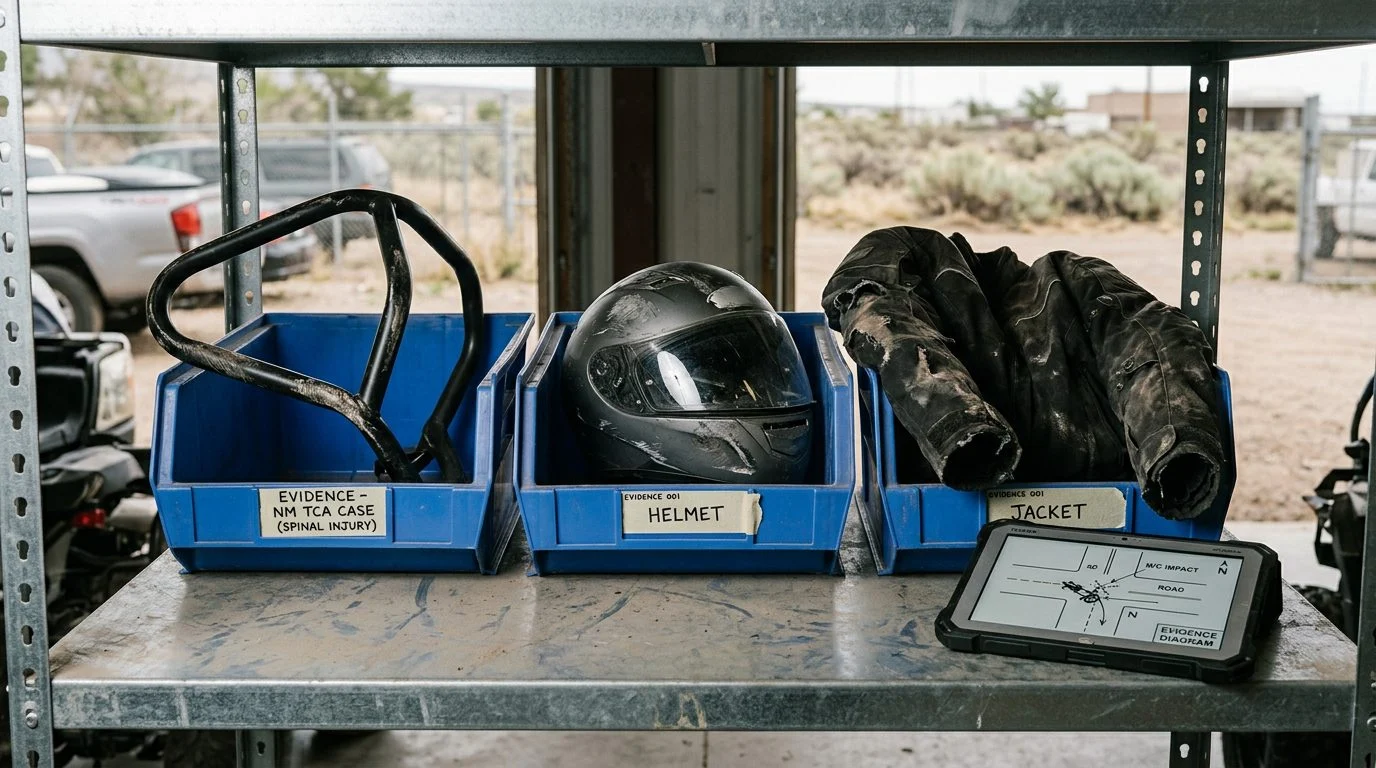
Spinal Cord Injury · New Mexico
Injured by a Government Vehicle or Property? Start With the Right Notice.
Claims involving public entities can follow procedures that differ from ordinary injury cases. Talk with our team about what your situation may require.
By Josh Wood · Published November 12, 2026
A spinal cord injury after a crash, fall, or other incident raises a hard question: was a public body involved? If you were hurt and a city, county, state agency, or public worker may be responsible, the New Mexico Tort Claims Act can set a short notice deadline for your claim.
Private defendants follow different rules. This page explains how the Tort Claims Act’s notice rules work with a spinal cord injury in New Mexico.
Short Answer: It Turns on Who Caused the Injury
The Tort Claims Act applies only when a government party caused the injury. It covers the state, local public bodies such as counties and cities, and their public employees acting within the scope of duty (§ 41-4-3 definitions).
It generally does not govern claims against private defendants, but a person acting on behalf or in service of a governmental entity in any official capacity, with or without pay, can fall within the Act’s definition of ‘public employee’. A private trucking company, a property owner that is not a public body, or a private driver follows ordinary negligence rules. A negligence claim generally requires a duty, a breach of that duty, and a breach that is a proximate cause of the damages (Herrera v. Quality Pontiac).
Independent contractors are generally excluded from the definition of public employee, except for certain listed individuals, such as licensed medical, psychological or dental arts practitioners providing services to the corrections department or the children, youth and families department under contract. A private company hired by a city may not fall under the Act (§ 41-4-3 definitions).
Many spinal cord injury cases involve both public and private parties. Each possible defendant needs its own review, because the notice and filing rules can differ.
If a public vehicle, road, or building may be part of your spinal cord injury, the notice clock may already be running, and we can talk through your facts with you. Talk it through with our team — the first consultation is free, confidential, and carries no obligation.
Which Public Entities and Employees Fall Under the Act
Immunity is waived for injuries caused by a public employee’s negligence while operating or maintaining a motor vehicle, aircraft or watercraft (§ 41-4-5). NMSA 1978, § 41-4-5 reads: “The immunity granted pursuant to Subsection A of Section 41-4-4 NMSA 1978 does not apply to liability for damages resulting from bodily injury, wrongful death or property damage caused by the negligence of public employees while acting within the scope of their duties in the operation or maintenance of any motor vehicle, aircraft or watercraft.” Public buildings, parks, and equipment have a parallel waiver (§ 41-4-6). NMSA 1978, § 41-4-6 reads: “The immunity granted pursuant to Subsection A of Section 41-4-4 NMSA 1978 does not apply to liability for damages resulting from bodily injury, wrongful death or property damage caused by the negligence of public employees while acting within the scope of their duties in the operation or maintenance of any building, public park, machinery, equipment or furnishings.”
A city bus, a county road crew, a state agency van, or a public school facility can fit these categories. The fit depends on what caused the injury.
Answering that early tells you which office receives notice and which deadlines apply.
The 90-Day Written Notice Requirement
The notice must state the time, place and circumstances of the loss or injury.
The recipient depends on the defendant. Claims against the state go to the risk management division. Municipal claims go to the mayor, school district claims to the superintendent, county claims to the county clerk, and other local public bodies to their administrative head (§ 41-4-16).
The 90 days run from the occurrence, not from the end of treatment. The statute excludes up to 90 days when the injury leaves the person unable to give notice.
Actual notice is a narrow exception. Written notice is not required if the governmental entity had actual notice of the occurrence (Lopez v. State). Treat the 90-day date as the working deadline.
Why a Spinal Cord Injury Makes Timing Harder to Judge
A spinal cord injury can make the notice date harder to plan around. The full picture may not be clear right away.
Symptoms such as numbness, tingling, weakness, or changes in mobility can shift over days or weeks. Early signs do not always show how the injury will look later. Learn more about early numbness and tingling after a crash.
The notice clock runs from the occurrence, not from a final diagnosis. Waiting for a full prognosis before acting can put the 90-day window at risk.
Keep the first treatment notes, emergency records, and imaging in one place. These records help show when and how the injury happened, and the notice must describe those circumstances.
Limits on Suing a Government Entity Under the Act
A governmental entity and its public employees acting within the scope of duty have immunity from tort liability. That immunity stands except where the Act waives it (§ 41-4-4).
A claim must fit one of the waivers. The list of categories in § 41-4-4(B) defines when the governmental entity must provide a defense for a public employee, not what is recoverable against the public body.
Filing has its own deadline.
The Act also caps damages. Medical expenses are capped at $300,000 for one occurrence. Other damages are capped at $400,000 per person, and total liability for real property and other damages from one occurrence cannot exceed $750,000 (§ 41-4-19).
Judgments under the Act cannot include punitive or exemplary damages or prejudgment interest (§ 41-4-19). These limits can shape how a spinal cord injury claim is valued, so the type of defendant matters early.
When Private Defendants Are Also Involved
A private defendant can face liability under ordinary negligence rules, even when a public body is also involved.
The Act’s caps and notice rules apply to governmental entities and public employees. Under NMSA 1978, § 41-4-16, a person who claims damages from the state or any local public body under the Tort Claims Act must present a written notice stating the time, place and circumstances of the loss or injury within ninety days after the occurrence giving rise to the claim (§ 41-4-16).
Against a private party, a personal-injury lawsuit generally must be filed within three years (§ 37-1-8 three-year rule). Under NMSA 1978, § 41-4-15, actions against a governmental entity or a public employee for torts are forever barred unless commenced within two years after the date of occurrence resulting in loss, injury or death, except that a minor under the full age of seven years has until his ninth birthday in which to file; this subsection does not apply to any occurrence giving rise to a claim that occurred before July 1, 1976 (§ 41-4-15).
More than one party can share responsibility. A proximate cause need not be the only cause of an injury (Herrera v. Quality Pontiac). Naming every responsible party early helps avoid losing one claim while pursuing another.
Not sure what your next step is?
Talk it through with our team — the first consultation is free, confidential, and carries no obligation.
Steps to Take Before the Notice Deadline
Start by writing down the date, the place, and the order of events while they’re fresh. Note every public vehicle, agency, or employee involved, including unit numbers or names if you have them.
Request the police or incident report. Keep the treatment records in one folder, and save copies of anything you send to a public office with the date it was delivered.
Track every deadline from the date of the occurrence. Mistakes people often make include:
- Counting from the day treatment ended.
- Assuming notice to a city also reaches a county or state agency.
- Waiting for a final diagnosis before acting.
Talk Through Your Situation With El Gringo Law
If you’re reading this for a family member who can’t handle the paperwork yet, you don’t have to face it alone. A public vehicle, road, or building may be part of the injury, and the 90-day clock may already be running.
The firm offers a free initial consultation that is confidential and carries no obligation to continue. You can share the date, the place, and who was involved through the contact form or by starting a chat on elgringolaw.com.
Josh Wood is the responsible lawyer for this page. He is licensed in New Mexico and Arizona. For more on damages in these cases, see spinal cord injury damages in New Mexico.
Quick Answers
Does the Tort Claims Act apply to a private trucking company?
The Act covers governmental entities and public employees, so a private company generally follows ordinary negligence rules instead.
How long do I have to give notice?
Written notice generally must be given within 90 days after the occurrence (§ 41-4-16).
How long do I have to file a lawsuit against a government entity?
Generally within two years after the occurrence (§ 41-4-15). NMSA 1978, § 41-4-15 reads: “Actions against a governmental entity or a public employee for torts shall be forever barred, unless such action is commenced within two years after the date of occurrence resulting in loss, injury or death, except that a minor under the full age of seven years shall have until his ninth birthday in which to file.”
How We Can Help
Reviewing Your Situation
We look at how your injury happened and who may be responsible, including whether a public entity is involved.
Tracking Notice Steps
We help you understand the paperwork and steps that may apply, so nothing important is missed along the way.
Focusing on Your Recovery
Our team handles the legal details so you can concentrate on medical care and family life.
Fighting for Fair Compensation
We advocate for compensation that reflects the full impact of a spinal cord injury on your life.
Don't Handle Notice Requirements Alone
Notice rules for claims against government entities can be strict and technical. Contact our team early so we can review your facts before you take any step on your own.
Injuries We Handle
Spinal Cord Injuries
Serious injuries to the spinal cord that can affect movement, sensation and independence over the long term.
Car and Trucking Accidents
Collisions involving passenger vehicles or commercial trucks, including situations where a public entity may share responsibility.
Premises Liability
Injuries caused by unsafe conditions on property, where the owner or manager may be responsible.
Catastrophic Injuries
Life-changing injuries that require ongoing medical care, rehabilitation and long-term planning.