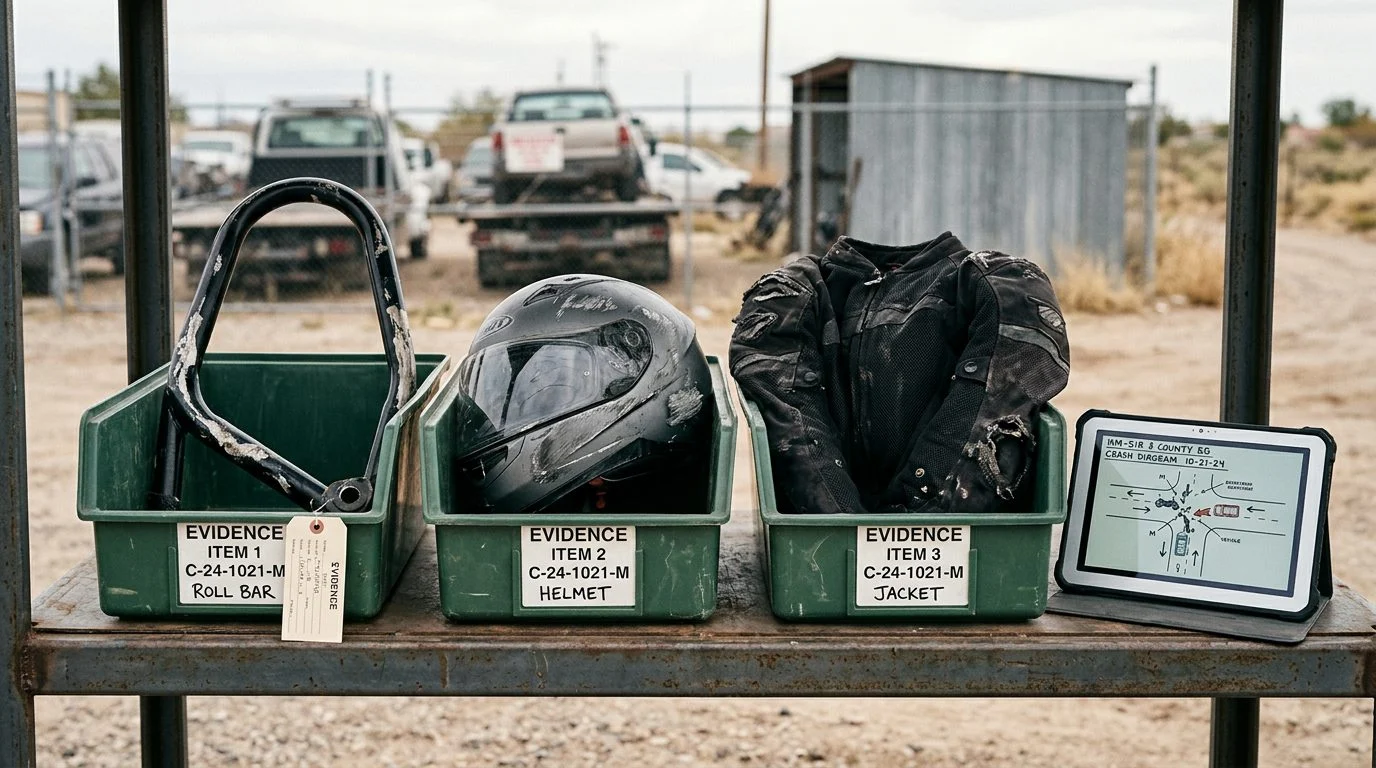
Wrongful Death · Car Accidents · New Mexico
Asked for a Recorded Statement After a Loved One's Fatal Crash? Talk to Us First.
An insurance adjuster may call soon after a family member dies in a crash. El Gringo Law can help you understand the call before you decide how to respond.
By Josh Wood · Published November 4, 2026
You can ask for time before you give an insurance adjuster a recorded statement about a fatal crash. Before you answer, you can ask who is calling, which company they represent, and why they want the statement. This page explains the request, what adjusters often ask after a death, and why your family’s answers can matter later. It is general information about New Mexico law, written for families deciding how and when to respond.
What a Recorded Statement Is and Why Adjusters Request One
A recorded statement is a spoken account of what you know about a crash. It is taken on audio or video, and the insurer can keep it and review it later. Adjusters often ask for one early, while memories are fresh and crash details are still easy to check. Their job includes building a claim file, and a recorded account goes into that file.
The request may arrive within days of a death. That is often when the family is arranging services, telling relatives, and trying to absorb a loss that feels impossible to take in. The call can feel urgent even when no decision is due that day. Many families feel pressure to answer quickly just to end the call.
This page explains what the request means so you can decide how to respond. It covers what the adjuster may ask, why answers can be used later, how New Mexico’s fault rules shape the questions, and when talking with a lawyer first can help.
Not sure what your next step is?
Talk it through with our team — the first consultation is free, confidential, and carries no obligation.

Do You Have to Give a Recorded Statement?
You can ask for time. You do not have to answer every question on the first call, and you can ask that questions be sent in writing.
Start by identifying who is asking. The at-fault driver’s insurer, your family’s own auto insurer, and any other party’s insurer may each request statements. Each company’s policy may use different terms, so the company matters. Ask the caller for the company name, the claim number, the adjuster’s name, and the reason for the request. Ask for a written request if one is available.
Write down the date, the time, and what was said. Keep the notes with your crash papers. A family member can take notes during the call if you are not ready to speak. You can say something simple, such as, “We are not ready to give a statement. Please send your questions in writing.” Then take the time you need to review the crash facts, the police report, and any letters you have received.
Questions an Adjuster May Ask After a Death
Expect basic questions first. The adjuster may ask for the date, time and location of the crash, the vehicles involved, the road and weather conditions, and how the crash happened. These questions look simple, and often they are. The problem comes when a rushed answer gets one detail wrong.
The adjuster may also ask about the person who died. Questions can cover speed, seat belt use, phone use, and that person’s condition before the crash. They may ask about health, medications, prior injuries or medical history, and who else was in the vehicle.
Family members may be asked what they saw, what they know about the crash, and their relationship to the person who died. They may also be asked about household income or the support the person provided. Insurers may use financial details when they value a claim, so answers in that area deserve care.
A question can seem small, but its answer can be quoted, compared with the police report, or used to dispute fault later. A common mistake is guessing at a detail you never saw. A better answer matches what you actually know. You can say you do not know when that is true, and you can ask the adjuster why a question matters.
Why Early Statements Can Be Used Later
A recorded statement becomes part of the claim file. The insurer can compare it with the police report, photos, medical records, and witness accounts. If the statement differs from another record, that difference may be raised later.
Small mistakes can matter. A guessed speed, an unclear time, or the wrong order of events can be presented later as a contradiction, even when the error was honest. That is one reason families should not speculate about what happened. People often speak in grief or shock. Those words still become part of the record, but a family can ask to clarify or correct information after reviewing the facts.
Crash reports are a separate kind of record. Section 66-7-213 of the New Mexico Statutes provides that all accident reports made by persons involved in accidents or by persons in charge of garages shall be without prejudice to the individual so reporting and shall be for the confidential use of the state highway and transportation department or other state agencies having use for the records for accident prevention purposes or for the administration of the state’s laws on deposits of security and proof of financial responsibility, subject to the limited disclosures that section allows. Except as that section provides, no accident report may be used as evidence in a civil or criminal trial arising out of an accident. A recorded statement to an insurer is a different kind of record, so handle it on its own terms.
Honest answers are the safest answers. “I don’t know” and “I was not there” are accurate when they are true. You do not need to fill a silence with a guess.
How New Mexico’s Fault Rules Affect the Adjuster’s Questions
New Mexico uses comparative negligence, which means a party’s own share of fault can reduce the damages recovered. The state adopted comparative negligence in Scott v. Rizzo in 1981. Under the uniform jury instruction on comparative negligence, the jury totals the damages, assigns percentages that add to 100%, and reduces the damages by the percentage of the injured party’s negligence.
Questions about the person who died are common for this reason. The insurer will look at how the crash happened and how much each person contributed. Answer those questions only on facts you know, and do not speculate about another person’s choices or intent.
New Mexico also limits how a defendant pays when several people’s fault contributed. Section 41-3A-1 of the New Mexico Statutes provides that, in causes of action to which several liability applies, any defendant who establishes that the fault of another is a proximate cause of a plaintiff’s injury shall be liable only for that portion of the total dollar amount awarded as damages to the plaintiff that is equal to the ratio of such defendant’s fault to the total fault attributed to all persons, including plaintiffs, defendants and persons not party to the action. Fault can therefore be divided among several people, and the division matters.
Fault questions turn on the facts of each crash. Keep your focus on what happened, what the records show, and what you personally saw.
When Talking With a Lawyer First Makes Sense
Talking with a lawyer before you answer is a common choice when the facts are complicated. Families often seek guidance first when a crash involved a commercial truck or a government vehicle, when the police report is unclear, when several vehicles were involved, or when questions turn to the deceased person’s conduct.
A lawyer can review the questions the adjuster is asking. A lawyer can identify which insurer is involved and what the policy may require. A lawyer can help the family decide whether, when, and how to respond. A lawyer can also handle communication with the insurer, so the family is not stuck on the phone with an adjuster during grief.
Families who think about suing an insurer directly should know one rule. In Hovet v. Allstate, the New Mexico Supreme Court held that a third-party claim against the at-fault driver’s insurer for failure to settle may be filed only after the underlying negligence case ends with a judicial finding of fault against the insured. A direct claim against the insurer follows the main case.
A family can speak with a lawyer before answering any question. The decision to continue with any firm remains the family’s.
Not sure what your next step is?
Talk it through with our team — the first consultation is free, confidential, and carries no obligation.
Deadlines That Can Run Alongside the Claim
Under NMSA 1978, § 41-2-2, every action instituted by virtue of this and the preceding section must be brought within three years after the cause of action accrues, and the cause of action accrues as of the date of death (NMSA 1978, § 41-2-2 — three years from the date of death). Adjuster talks and court deadlines run on separate tracks, so keep the date of death in view from the first call.
That same section sets a three-year limitation period and the rule for when that period begins to run. Loss of consortium damages belong to the family member who suffered the loss, not to the decedent’s estate, as stated in Thompson v. City of Albuquerque.
When a government entity may be responsible, the Tort Claims Act sets shorter timelines. Section 41-4-16 of the New Mexico Statutes requires every person who claims damages from the state or any local public body under the Tort Claims Act to give the official that section designates a written notice of the time, place and circumstances of the loss or injury within ninety days after the occurrence, unless the governmental entity had actual notice of the occurrence; the ninety days do not include up to ninety days during which the injured person is incapacitated by the injury from giving notice. For a wrongful death claim under that Act, notice may be presented within six months after the occurrence of the injury which resulted in the death, by or on behalf of the personal representative of the deceased person or any person claiming benefits of the proceeds of a wrongful death action, or the consular officer of a foreign country of which the deceased was a citizen; but if the person for whose death the claim is made has presented a notice that would have been sufficient had he lived, an action for wrongful death may be brought without any additional notice. Section 41-4-15 of the New Mexico Statutes provides that actions against a governmental entity or a public employee for torts shall be forever barred, unless such action is commenced within two years after the date of occurrence resulting in loss, injury or death, except that a minor under the full age of seven years shall have until his ninth birthday in which to file.
Government-entity dates are short, and the notice rules differ from ordinary claims. Do not assume a longer period applies. Ask about the deadlines early.
Frequently Asked Questions
Do I have to give a recorded statement after a family member died in a crash?
You can ask for time before you answer, and you can ask for questions in writing. Take the time you need to review the facts first.
Can an adjuster call me at home or at work?
Adjusters can call, so ask them to identify the company, the claim number, and the reason for the call. You can ask that future contact be scheduled.
Who can bring a wrongful death claim in New Mexico?
The personal representative of the person who died brings the action.
Does talking to a lawyer mean my family has to file a claim?
No. A consultation helps you learn your options, and your family decides what to do next.
What if my family already gave a statement?
Your family can speak with a lawyer about clarifying or adding to what was said.
Talk With Josh Wood Before You Answer the Adjuster’s Questions
If an adjuster has asked your family for a recorded statement after a fatal crash, you can pause before you answer. Your family is deciding what to say, and when, during a hard time. That decision can wait until you understand the questions in front of you.
Contact us through the contact form to request a free, confidential first consultation with Josh Wood, with no obligation to continue.
Josh Wood is the responsible lawyer for this page. Josh Wood is licensed in New Mexico and Arizona. El Gringo Law can be reached through its website at elgringolaw.com.
How El Gringo Law Can Help
Confidential Free Consultation
Call, use our contact form, or start a chat. Your first consultation is free, confidential, and comes with no obligation to continue.
Guidance Before You Speak
We can explain what an adjuster is asking, what the statement may be used for, and how to answer carefully.
Communication With the Insurer
We focus on handling insurance contact so your family is not left to answer questions alone during a difficult time.
Support for Grieving Families
Our team understands that a fatal crash affects the whole family, and we treat every call with patience and respect.
Before You Give a Recorded Statement
Adjusters can call you soon after a crash. Ask for the adjuster's name, company, and claim number, and ask what the call is about. If you are not ready, you can ask for time to review the facts. Speaking with a lawyer first can help you make informed decisions.
Steps to Take When an Adjuster Calls
Confirm Who Is Calling
Get the adjuster's name, the insurance company, and the claim number before you continue the conversation.
Ask for Questions in Writing
Requesting written questions gives you time to review each one and respond accurately.
Take Time to Review
Grief can make details hard to recall. Ask for time to gather the facts before you answer.
Keep Your Own Notes
Record the date, time, and what was discussed, and share them with your lawyer.