Trucking Accidents | New Mexico
Semi Truck Accident Lawsuit Process in New Mexico: What Happens After the Crash
Trucking cases involve more parties, more paperwork and more evidence than a typical car accident. Here is how a semi truck lawsuit generally moves forward, and how El Gringo Law can help you through each step.
By Josh Wood · Published November 2, 2026
What steps happen after hiring a lawyer for a semi-truck crash in New Mexico, from investigation through filing a claim or lawsuit?
After a lawyer takes the case, the work usually moves in order. It starts with investigation and evidence preservation, then a claim to the insurers, then a lawsuit if the claim does not resolve. Discovery follows, and the case ends in settlement or trial.
The stages overlap, and some run at the same time. How long each one takes depends on the injuries, the number of parties, and how the insurers respond.
This page takes the stages in order. Legal terms are explained where they first appear, so you don’t need a legal background to follow along.
If a semi truck crash has left you or a family member dealing with injuries and insurance calls, our team is ready to talk through the next steps. Talk it through with our team — the first consultation is free, confidential, and carries no obligation.

Investigation and evidence preservation in a semi-truck crash
Early work on a semi-truck case focuses on keeping evidence from disappearing. Trucking companies keep many records, and some are kept for only a limited time.
One early step is a written request, often called a preservation letter. It asks the carrier and its insurer to keep records such as driver logs, dispatch and phone records, maintenance files, and inspection reports.
Federal rules set minimum keeping periods. A motor carrier must keep records of duty status and supporting documents for at least six months from the date it receives them (49 CFR 395.8). The driver qualification file must be kept while the driver works there and for three years after (49 CFR 391.51).
Testing matters too. Alcohol testing attempts must stop after eight hours, and controlled substance testing attempts after 32 hours. Those crashes include ones with injuries that need immediate treatment away from the scene, or a vehicle towed away. If an alcohol test is not given within two hours, the employer must record why. Attempts to give an alcohol test stop after eight hours; for controlled substance tests, attempts stop after 32 hours.
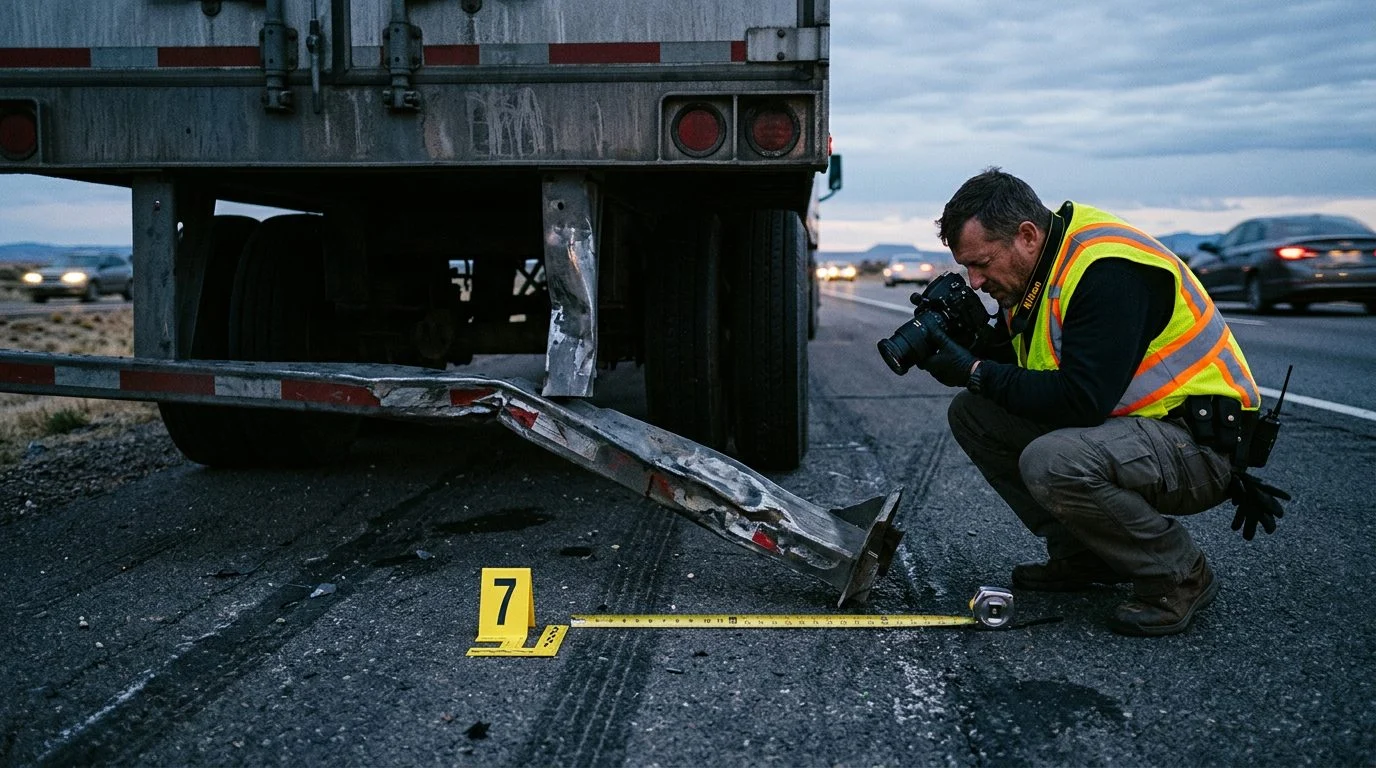
Scene work comes next. The investigation gathers the crash report, photographs, and names of witnesses. It also asks whether the truck and trailer can be kept. Medical records and treatment timelines round out the injury picture.
Who may be responsible in a semi-truck crash
A semi-truck case can involve more than the driver. Other possible parties include the trucking company, a leasing company, the vehicle owner, a maintenance contractor, and a company that loaded the cargo. Which of these may be liable depends on the facts of the crash and what the records show.
Responsibility is traced through relationships. Employment, leasing, and contract agreements each create records, and those records are requested separately.
New Mexico divides fault among defendants. In New Mexico causes of action to which several liability applies, any defendant who establishes that the fault of another is a proximate cause of a plaintiff’s injury is liable only for that portion of the total dollar amount awarded as damages to the plaintiff that is equal to the ratio of that defendant’s fault to the total fault attributed to all persons, including plaintiffs, defendants and persons not party to the action (N.M. Stat. § 41-3A-1).
Claims can also target a company’s own conduct. In a negligent entrustment claim, the plaintiff must show the owner gave a vehicle to a driver it knew or should have known was incompetent, and that the incompetence caused the injury (DeMatteo v. Simon). New Mexico courts also recognize negligent supervision claims against employers (Estate of Gutierrez).
The other driver’s auto insurance and the trucking company’s commercial coverage may both come into the claim.
The insurance claim and settlement demand
The insurance claim is the formal request for payment. It goes to the responsible insurers with proof of the crash, the injuries, the treatment, and the financial losses.
A settlement demand is the written request for compensation. It lays out the evidence from the investigation and explains the losses. Insurers review it. They may make an offer, ask for more information, or dispute fault or damages. Talks can take time, and each claim moves differently.
Settlement talks have limits in court. Under Rule 11-408, offers and statements made during compromise talks generally cannot be used to prove or disprove the validity or amount of a disputed claim, or to impeach by a prior inconsistent statement or contradiction, with limited exceptions (Rule 11-408 NMRA).
Keep your own records. Save medical bills, pay stubs, and letters from insurers. Once a lawyer represents you, send adjuster calls to that lawyer.
Filing a claim or lawsuit in New Mexico
A lawsuit begins when a complaint is filed in court. The complaint names each party believed responsible. Filing happens when the claim cannot be resolved with the insurers.
Under New Mexico law, actions for an injury to the person or reputation of any person must be brought within three years (N.M. Stat. § 37-1-8). Other deadlines and exceptions can apply. So the deadline should be reviewed early.
Starting early also gives the investigation time to work. It does not mean a decision must be rushed.
Each then has a set time under the court rules to respond. The response may admit or deny the claims and raise defenses.
Court filing fees and other litigation expenses start at this stage. The costs section below covers them.
Discovery, experts, and mediation
Discovery is the exchange of information before trial. Each side asks written questions and requests documents. It also takes depositions, which are recorded interviews given under oath before trial. Drivers, company representatives, and witnesses are often deposed.
Truck cases often use experts. An accident reconstruction expert can explain how the crash happened, based on physical evidence and data. Trucking-industry, medical, and economic experts can address safety practices and the losses. Experts charge fees, and those fees are litigation expenses.
Mediation is a session with a neutral mediator, a person who helps both sides talk. The session is generally confidential, and both sides try to reach a settlement. Many cases settle at some point in this process. Any settlement needs your approval before it is accepted.
Not sure what your next step is?
Talk it through with our team — the first consultation is free, confidential, and carries no obligation.
Trial, costs, and litigation expenses
Trial involves jury selection, presentation of evidence, witness testimony, and a verdict. A case can also settle at any point before a verdict.
Punitive damages (extra damages meant to punish) may be sought in some cases. A jury may consider them only if the injured person should recover compensatory damages, and the conduct was malicious, willful, reckless, wanton, fraudulent, or in bad faith (UJI 13-1827 NMRA). Whether a case meets that standard is decided case by case.
The firm may advance court costs and litigation expenses. Those advances are repaid only from a recovery. If there is no recovery, you may be responsible for court costs and the expenses of litigation. Your written fee agreement sets out these terms, and you review it before you sign.

Talking with a New Mexico truck accident lawyer about your situation
If you’re reading this after a semi-truck crash, you may be dealing with injuries, insurance calls, and a decision about who should handle the claim. You may be reading for a family member who is still recovering, or for one who has died.
Records can disappear, and a filing deadline may already be running. The question in front of you is whether to have a lawyer involved now.
How long do I have to file a semi truck lawsuit in New Mexico?
New Mexico law generally gives three years for an action for injury to a person. Other deadlines can apply, so start the review early.
Can I still recover if I was partly at fault?
Under New Mexico’s comparative negligence jury instruction, the plaintiff’s total damages are reduced by the percentage of the plaintiff’s negligence (UJI 13-2218 NMRA).
Can settlement talks be used as evidence?
Generally no. Under Rule 11-408, statements made during compromise talks generally cannot be used to prove or disprove the amount of a disputed claim.
Josh Wood, the lawyer responsible for this page, is licensed in New Mexico and Arizona. El Gringo Law can be reached through its contact form or at elgringolaw.com. The initial consultation is free, confidential, and comes with no obligation to continue (consulta inicial gratuita, confidencial y sin compromiso).
Why Early Steps Matter in a Truck Crash Case
Evidence can disappear
Trucking companies keep logs, maintenance records, dispatch data and driver files. Early requests help make sure that information is preserved while the facts are still fresh.
Scene and vehicle documentation
Photos, skid marks, damage patterns and witness contact details are harder to collect weeks later. A lawyer can help organize what you already have.
Several parties may be involved
A semi truck crash can involve the driver, the carrier, the cargo company, maintenance contractors and insurers. Identifying each one is a core part of the case.
Insurance adjusters work for the other side
Adjusters for trucking companies may ask for recorded statements or quick settlements. Speaking with a lawyer first can help you understand what you are agreeing to.
The Semi Truck Lawsuit Process, Step by Step
1. Free, confidential consultation
You describe what happened, and we review the crash details, your injuries and any paperwork you have. The first consultation is free, confidential and comes with no obligation to continue.
2. Investigation and evidence preservation
We work to identify the trucking company, the driver and other responsible parties, and we request key records such as electronic logs, maintenance files and driver qualification documents.
3. Filing the lawsuit and discovery
If a claim proceeds, a complaint is filed in court. Both sides then exchange information through discovery, which may include written questions, document requests and depositions.
4. Negotiation, mediation or trial
Many cases are resolved through settlement talks or mediation. If a fair resolution cannot be reached, the case may go to trial.
Be Careful With Recorded Statements
A trucking company's insurer may contact you soon after a crash and ask for a recorded statement. Before you give one, consider talking with a lawyer about what to say and what to avoid.
Ready to talk about your semi truck accident?
Contact El Gringo Law for a free, confidential consultation with no obligation to continue. Josh Wood is the responsible lawyer for this page.