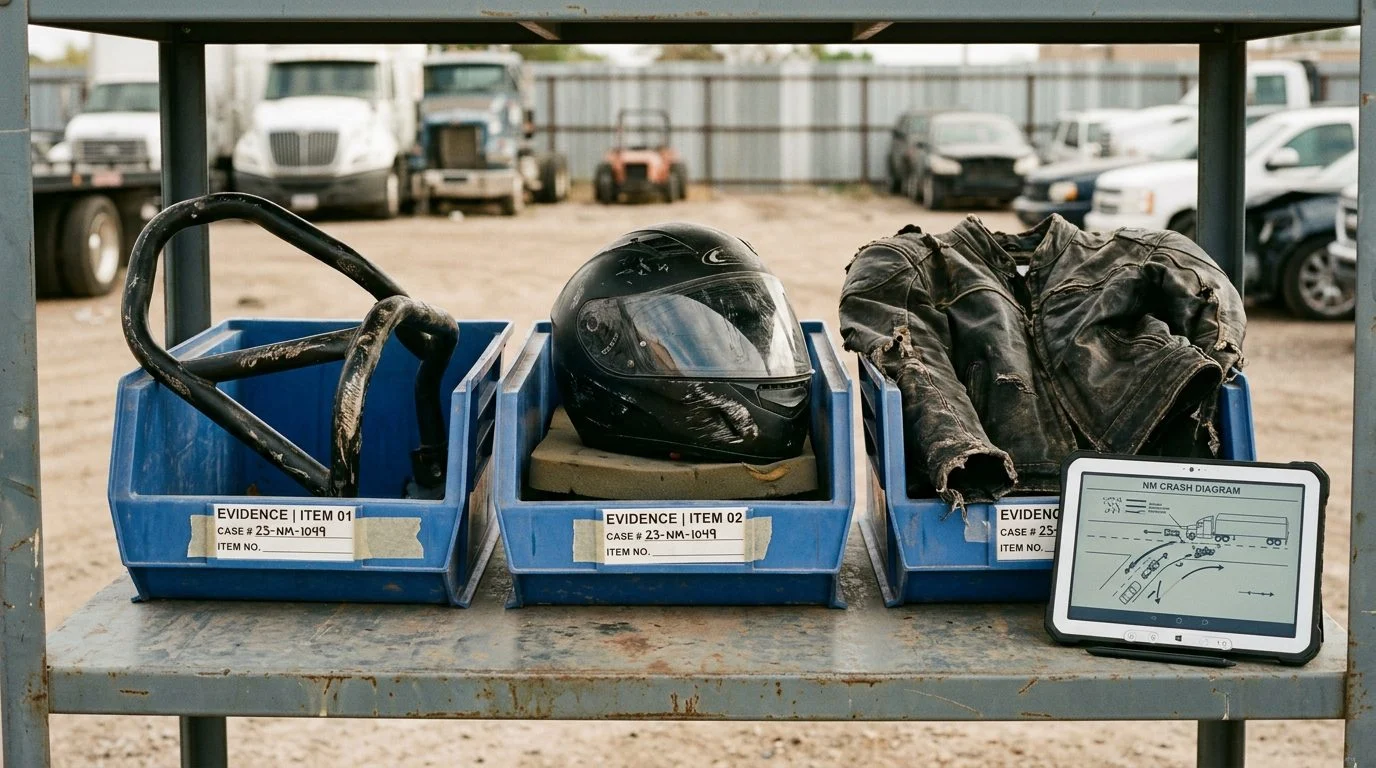
Truck Accidents · New Mexico
Who Can Be Held Responsible After a Truck Crash in New Mexico?
A truck crash often involves more than one company or person. Learn which parties may share responsibility, and how a free, confidential first consultation with El Gringo Law can help you understand your options.
By Josh Wood · Published November 3, 2026
After a truck crash, one of the first questions is who could be responsible. The answer is often more than one person or company. This page explains the parties most often named in New Mexico and how the state divides fault among them.
Which parties can be held liable in a truck crash, such as the driver, the trucking company, the cargo loader, or the truck maintenance contractor?
Several truck crash liability parties can be held liable in a truck crash. These often include the driver, the trucking company, a cargo loader or shipper, and a maintenance contractor. Which of them apply depends on the facts.
A truck crash rarely has just one cause. A tired driver, a poorly secured load, and a worn part can each play a role. Each one may point to a different party.
Under New Mexico law, a cause does not have to be the only cause. A proximate cause (the legal link between conduct and injury) is one that produces the injury in a natural and continuous sequence. It need not be the only, last, or nearest cause, as Herrera v. Quality Pontiac explains.
The sections below cover each party. The last section explains how New Mexico divides fault among them.
If someone you care about was hurt in a truck crash, our team can talk with you about who may be responsible and what comes next. Talk it through with our team — the first consultation is free, confidential, and carries no obligation.
The Truck Driver
The truck driver can be held liable for his or her own unsafe driving. Common issues include fatigue, distraction, speeding, impairment, and ignoring traffic rules.
Federal rules limit driving time. Under 49 CFR 395.3, a driver may not drive without first taking 10 consecutive hours off duty. A driver also may not drive after a 14-consecutive-hour period that starts when the driver comes on duty after 10 hours off. Within that period, the driver may drive a total of 11 hours.
A separate rule addresses impairment. Under 49 CFR 392.3, a driver may not operate a commercial vehicle when fatigue, illness, or another cause impairs, or is so likely to impair, the driver’s ability or alertness as to make it unsafe to do so, except in a case of grave emergency where compliance would increase the hazard, in which case the driver may continue to the nearest place where that hazard is removed.
A driver can be named as a defendant for his or her own negligence. A rule violation is one fact among many. The key question is whether the driver’s conduct helped cause the crash and the injuries.
The Trucking Company and Its Own Decisions
A trucking company can be held liable for its driver’s conduct and for its own decisions. Two separate routes are common.
A plaintiff may sue an employer under respondeat superior when the employee was acting within the scope of employment; under a theory of negligent hiring, retention, and supervision, recovery does not require that the employee be acting within the scope of employment. The UJI 13-1647 NMRA committee commentary describes this rule.
The second route is the company’s own negligence. The defendant was the employer of the employee. The defendant was the employer of the employee. The employer knew or should have known the employee would create an unreasonable risk of injury to a group or class that includes the plaintiff. The employer failed to use ordinary care in hiring, retaining, or supervising. That failure caused the injury. This route does not require that the driver was working when the crash happened.
A related claim, negligent entrustment, applies when a company hands a vehicle to a driver it knew or should have known was incompetent. The plaintiff must show the entrustment, the knowledge, and that the driver’s incompetence caused the injury. See DeMatteo v. Simon.
Federal rules also place duties on the carrier. Under 49 CFR 390.11, a motor carrier must require drivers to observe the driver rules. The carrier and the driver are not always the same company. It matters who hired the driver and who controlled the truck at the time of the crash.
The Cargo Loader and the Shipper
A cargo loader or shipper can share responsibility if poorly secured cargo contributed to the crash. Federal rules require that cargo be firmly immobilized or secured on or within a vehicle, except bulk commodities that lack structure or fixed shape (such as liquids, gases, grain, or sand) and are carried in a tank, hopper, box, or similar device that forms part of the vehicle’s structure. Under 49 CFR 393.106, cargo must be firmly immobilized or secured with structures of adequate strength, dunnage, shoring bars, tiedowns, or a combination of these, except for commodities in bulk that lack structure or fixed shape (e.g., liquids, gases, grain, liquid concrete, sand, gravel, aggregates) carried in a tank, hopper, box, or similar device that forms part of the vehicle.
Shifting cargo can change how a truck handles. A load that moves can unbalance a trailer, cause a rollover, or lead to loss of control. Articles that are likely to roll must be restrained with chocks, wedges, a cradle, or an equivalent means.
The loader may be a different company from the carrier. Shipping and loading paperwork can show who handled the freight and when. Whether a loader or shipper bears any share turns on what the records and the crash investigation show.
Truck Maintenance Contractors and Parts Makers
A maintenance contractor can share responsibility if faulty or incomplete repair work contributed to a mechanical failure. A parts maker can be involved if a defective part played a role.
Federal rules require carriers to keep their vehicles safe. Under 49 CFR 396.3, every motor carrier must systematically inspect, repair, and maintain its vehicles. Parts and accessories must be kept in safe and proper operating condition at all times. The rule names frame, suspension, axles, wheels, and steering systems.
Mechanical problems such as brake or tire failure can contribute to a crash. A failure may trace back to a maintenance decision, a repair, or a part. Each one can lead to a different party.
Carrier records matter here too. Under the same rule, carriers, except for a private motor carrier of passengers (nonbusiness), must keep inspection, repair, and maintenance records for each vehicle they control. Those records must be kept for 1 year where the vehicle is housed or maintained, and for 6 months after it leaves the carrier’s control.
How New Mexico Divides Fault Among Several Parties
New Mexico assigns each person a share of fault, and a defendant generally pays only its share. Under NMSA § 41-3A-1(B), in causes of action to which several liability applies, a defendant that establishes another’s fault is a proximate cause of the plaintiff’s injury is liable only for the portion of the total dollar amount awarded as damages that equals the ratio of its fault to the total fault attributed to all persons, including plaintiffs, defendants and persons not party to the action. That total includes the plaintiff and any non-party.
The jury works through this in steps. Under UJI 13-2219 NMRA, the jury first finds the total damages. It then compares the negligence, if any, of the injured person, each defendant, and any non-parties, and sets a percentage for each. The percentages must total 100% for the people whose negligence caused the damage.
Comparative negligence (shared fault) came to New Mexico in Scott v. Rizzo, according to the same UJI commentary. This means the injured person’s own share counts in the math.
There are exceptions. Under § 41-3A-1(C), joint and several liability (where one party can be responsible for the full amount) still applies in listed situations. Those include vicarious liability between persons whose relationship makes one liable for the other, and strict liability for a defective product. Even in those cases, joint and several liability applies only to the portion of the total liability attributed to those persons together.
Not sure what your next step is?
Talk it through with our team — the first consultation is free, confidential, and carries no obligation.
Why Records and the Crash Investigation Matter
Records often show who did what before the crash. Common sources include the police report, driver logs, electronic logging device data, dash camera video, maintenance records, cargo paperwork, and witness statements.
Records can be kept in different forms. Under 49 CFR 379.7, records may be preserved by any technology that accurately reflects the information and stays accessible for later reference.
Time matters. Carriers keep some records only for set periods, as noted above. Video and electronic data can also be overwritten through routine use. Early attention to these sources helps everyone understand the facts.

Talk With El Gringo Law About Your Truck Crash
You can talk with El Gringo Law about the parties involved in a truck crash, including the driver and the company. You may be reading this while a family member recovers from injuries. You may also be handling calls, bills, and paperwork you never expected.
If you want to talk through what happened, reach our team through our contact form. Our first consultation is free, confidential, and carries no obligation to continue. Josh Wood is the lawyer responsible for this page, and he is licensed in New Mexico and Arizona.
Frequently asked questions
Who can be held liable in a truck crash?
More than one party may share responsibility for a truck crash: a driver, cargo loader, shipper or maintenance contractor for their own negligent acts, and the trucking company both for its own negligence and, under respondeat superior, for the conduct of a driver who was acting within the scope of employment.
Can a trucking company be sued for its driver’s crash?
Yes. A plaintiff may sue an employer under respondeat superior when the employee was acting within the scope of employment.
Does New Mexico split fault among several parties?
Yes. Under NMSA § 41-3A-1, where several liability applies, a defendant that establishes that the fault of another is a proximate cause of the plaintiff’s injury is liable only for the portion of the total dollar amount awarded as damages that matches its share of the total fault attributed to all persons, including plaintiffs, defendants and persons not party to the action.
Parties That May Share Responsibility in a Truck Crash
The Truck Driver
A driver may be responsible for their own negligent actions, such as distracted driving, fatigue, or unsafe maneuvers that contribute to a crash.
The Trucking Company
The company may answer for its own negligence, such as inadequate hiring, training, or supervision, and may also answer for a driver acting within the scope of their work.
Cargo Loaders and Shippers
Improperly loaded or secured cargo can shift and cause a crash.
Maintenance Contractors
A repair or maintenance provider whose work on brakes, tires, or other equipment was careless may share responsibility if that work contributed to the crash.
Before You Speak With an Insurer
Insurance adjusters for trucking companies often contact injured people quickly. Consider speaking with our team before giving a recorded statement or signing any release.
How El Gringo Law Approaches Truck Crash Cases
Identifying All Potentially Responsible Parties
Our team looks beyond the driver to examine the companies, contractors, and others whose conduct may have contributed to the crash.
Working With Your Family
We explain each step in plain language and keep you informed about your case, whether you are injured or helping a loved one.
Focused on Serious Injuries
Our practice focuses on car and truck accidents, catastrophic injuries, spinal cord injuries, and wrongful death, and we understand how heavily these cases weigh on families.
A Free, Confidential First Consultation
Your first consultation is free, confidential, and comes with no obligation to continue. It is a chance to ask questions about your situation.