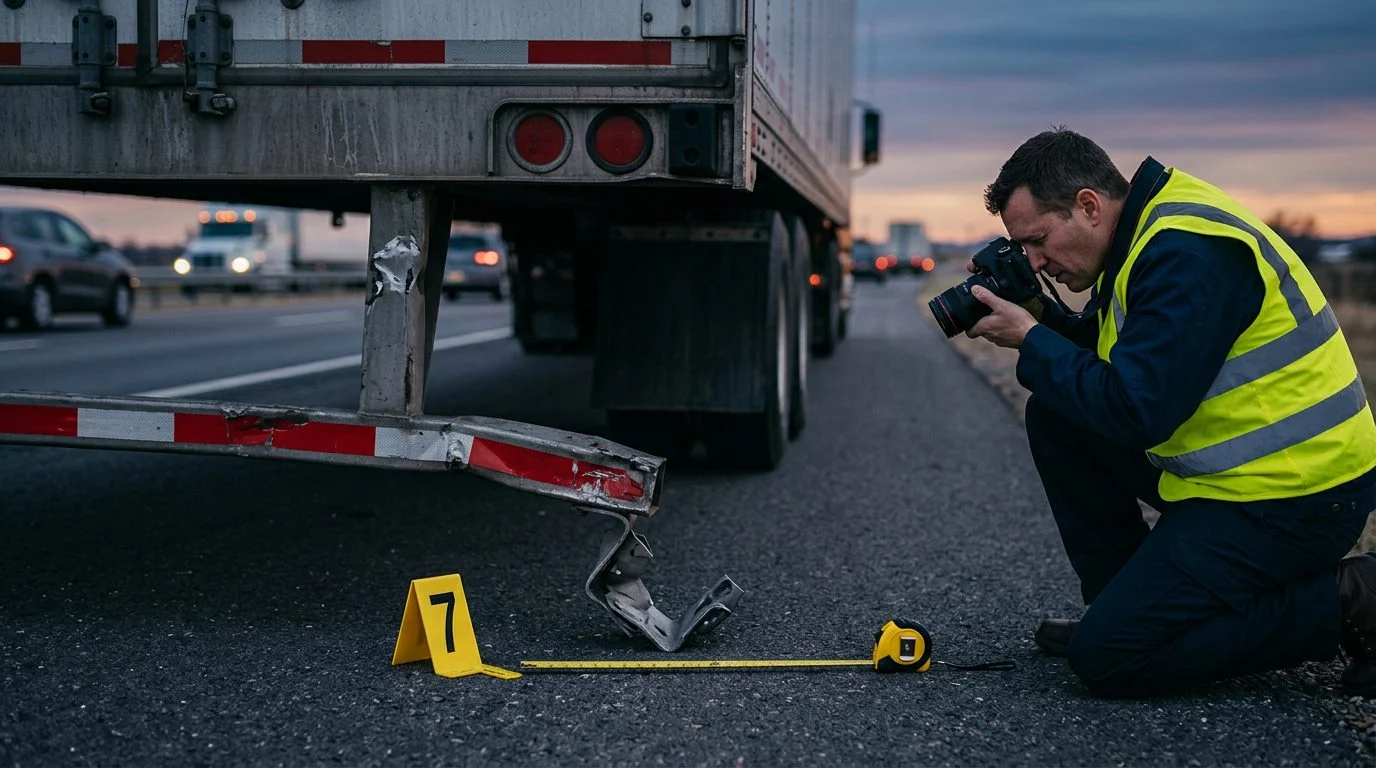
Semi Truck Accidents | New Mexico
Hit by a semi in New Mexico? Start with the questions that protect your claim.
Trucking crashes involve more parties, more paperwork, and more fast-moving insurance calls than a typical car accident. Here is how to get oriented.
By Josh Wood · Published November 9, 2026
When a semi truck hits you in New Mexico, the big question is who pays. You’re probably dealing with medical bills, a damaged vehicle, and insurance calls all at once.
Most of the money usually comes from the insurance tied to whoever is found at fault. In a truck crash, that can include the driver, the trucking company, and the company’s insurer.
Who Pays After a Semi Truck Crash in New Mexico?
Payment usually comes from the liability insurance of the party found at fault. In a semi truck crash, that can mean the driver, the trucking company, or both. The answer depends on the facts of the crash, including who was driving, who owned or leased the truck, and what caused the collision. For the wider picture, read our guide to trucking accident claims in New Mexico.
More than one party can share blame. A crash may involve a carrier, a maintenance provider, or a company that loaded the cargo. Each one may carry insurance that can help pay.
Not every payer is obvious at the scene. Some links in the chain only show up later, once someone looks at the records. Early attention to who was involved makes it easier to identify every source. Your own policy may also play a role.
If a semi truck hit you and insurers are already calling, you may have a claim, and our team can help you sort out who owes what. Talk it through with our team — the first consultation is free, confidential, and carries no obligation.
The Truck Driver and the Trucking Company
A driver can be liable for his or her own careless driving. A trucking company can be liable in some situations too.
Driver negligence is the most direct claim. Speeding, distracted driving, and following too closely are common examples. New Mexico’s following-too-closely rule says a driver must keep a distance that is reasonable and prudent. Under NMSA § 66-7-318, the driver of a motor truck or motor vehicle drawing another vehicle shall not follow another such vehicle within three hundred feet when traveling outside a business or residence district, except that this does not prevent overtaking and passing. NMSA 1978, § 66-7-318
A trucking company’s responsibility can rest on different grounds. Under the commentary to UJI 13-1647 NMRA, a company can be liable for its employee’s conduct (respondeat superior) if the employee was acting within the scope of employment. A company can also face claims for its own decisions, such as how it hired, trained, supervised or maintained drivers. Spencer v. Health Force describes a direct duty an employer owes to people it might reasonably expect to be placed at risk.
Who gets named depends on who owned, leased, or operated the truck. Owner-operators, leased equipment, and company-owned trucks can each change the picture. For more on that question, read about suing a trucking company or driver.
Which Insurance Policies May Respond to Your Claim
The at-fault party’s liability insurance is usually the main source of payment for injury and property damage.
Federal law directs the Secretary of Transportation to set minimum insurance levels for motor carriers. For example, the federal schedule lists $750,000 of public liability for for-hire carriers hauling nonhazardous property in interstate commerce, with a truck rated at 10,001 pounds or more. 49 C.F.R. § 387.9. Actual policy limits can be higher.
Your own auto policy may matter too. NMSA 1978, § 66-5-301. Medical payments coverage on your own policy may also apply, depending on its terms.
Insurers often ask for a recorded statement early. Before you give one, talk with our team so you know what is being asked and why.
How Fault Is Divided Under New Mexico Law
New Mexico uses pure comparative negligence. Your share of fault lowers what you recover, but it does not bar recovery. Scott v. Rizzo adopted that standard, so a plaintiff is no longer totally barred because of their own negligence.
In causes of action to which several liability applies, NMSA § 41-3A-1 makes a defendant who shows that another’s fault was a proximate cause of the plaintiff’s injury liable only for the portion of the damages equal to that defendant’s share of the total fault attributed to all persons. Joint liability still applies in some settings, such as when one party is legally responsible for another’s acts.
Here is an illustration, not a prediction. Under UJI 13-2219 NMRA, the jury totals the damages and assigns each party a percentage of fault. Each defendant’s percentage is multiplied by the total damages. If a jury found you 20 percent at fault and total damages were $100,000, the defendants’ shares would total $80,000.
Fault is decided on the facts and evidence in each case. Past results do not predict a similar outcome.
What Compensation May Cover After a Semi Truck Collision
Claims after a truck crash often cover medical care, lost income, vehicle damage, and pain and suffering.
Medical bills, both past and future, are a common part of the claim. Lost wages matter, and so does lost earning ability if an injury limits the work you can do. Property damage covers your vehicle and the personal items inside it.
Some crashes cause catastrophic injuries, such as spinal cord injuries, amputations, and burn injuries. Those cases often involve long recovery periods and lasting changes to daily life. The firm handles catastrophic injury claims.
If a crash causes a death, New Mexico’s Wrongful Death Act allows a claim. The person who would have been liable had death not ensued is liable in an action for damages. The history note of NMSA § 41-2-1 reads: “History: Laws 1882, ch. 61, § 2; C.L. 1884, § 2309; Laws 1891, ch. 49, § 1; C.L. 1897, § 3214; Code 1915, § 1821; C.S. 1929, § 36-102; 1941 Comp., § 24-101; 1953 Comp., § 22-20-1.” Close family members may have their own loss of consortium claim. Thompson v. City of Albuquerque explains that this claim belongs to the family member, not to the injured person or the estate.
Time Limits That Control Your Claim
NMSA § 37-1-4 sets a four-year limit for actions brought for injuries to property, for the conversion of personal property, or for relief upon the ground of fraud. Vehicle damage may run on a different clock than injury claims.
A wrongful death action must be brought within three years after the cause of action accrues (NMSA § 41-2-2), and the cause of action accrues as of the date of death. The cause of action accrues as of the date of death. NMSA 1978, § 41-2-2.
Waiting also makes proof harder to gather. Photos, witness names, and crash records are easier to find soon after a crash. Those details can matter when fault is disputed. You can start the conversation early, even while treatment is ongoing.
Not sure what your next step is?
Talk it through with our team — the first consultation is free, confidential, and carries no obligation.
How the Free Consultation Works
A consultation is a chance to sort out who may owe you money before you decide anything.
The firm offers a free, confidential initial consultation with no obligation to continue (consulta inicial gratuita, confidencial y sin compromiso).
Bring what you have: any crash report, insurer letters, medical bills, photos, and notes about the truck’s company name and markings. These details help identify possible payers and the insurance behind them. The conversation focuses on your questions about insurers, deadlines, and the parties involved.
Frequently Asked Questions
Who pays if a semi truck hits me in New Mexico?
Usually the insurance tied to whoever is found at fault. That may include the driver, the trucking company, or both.
Can I sue the trucking company or only the driver?
You may be able to name both. The answer depends on who employed the driver and who owned or leased the truck.
Can you still claim after three years?
New Mexico’s statute sets three years for an injury to a person, so waiting can put a claim at risk.
Is New Mexico a comparative fault state?
Yes. New Mexico uses pure comparative negligence, so your share of fault lowers what you recover but does not bar it.
Talk With El Gringo Law About Who Pays for Your Losses
If a semi truck hit your vehicle, and you’re juggling bills, missed work, and an insurer’s questions, you don’t have to sort out the payers alone. Josh Wood, licensed in New Mexico and Arizona, is the responsible lawyer for this page. Reach the firm through the online contact form on elgringolaw.com.
How El Gringo Law approaches a semi truck case
Early preservation
We focus on requesting and preserving crash reports, driver logs, maintenance records, and dashcam footage while they are still available.
Every party considered
Trucking cases can involve the driver, the carrier, the vehicle owner, and others. We look at each connection to the crash.
Medical and financial impact
We help you document injuries, treatment, lost income, and daily limits so the full picture is presented.
Clear communication
Our team keeps you informed about what is happening and what decisions are ahead, in plain language.
Be careful before you talk to an insurer
Trucking companies and their insurers may contact you quickly. Speak with a lawyer before you give a recorded statement, sign a release, or accept any settlement offer.
Questions people ask after a semi truck crash
Who could be involved?
Depending on the facts, the driver, the trucking company, the company that leased the truck, and others may be connected to the crash. Each situation is different.
Why does the trucking company matter?
Employment and ownership arrangements can affect who is named in a claim. We review those records as part of the investigation.
What evidence should be preserved?
Photos, witness information, the police report, your medical records, and records of lost work can all matter. Keep copies of everything you receive.
What if the injuries are serious?
Catastrophic injuries, spinal cord injuries, amputations, and burns often require long-term planning. We can help you understand the scope of your losses.