Truck Accidents | New Mexico
Hurt in a Truck Crash? Learn How New Mexico Looks at Shared Fault
A plain-language guide from El Gringo Law to comparative negligence in truck accident cases, with a free, confidential first consultation.
By Josh Wood · Published November 2, 2026
Can I still recover compensation after a truck crash in New Mexico if I was partly at fault under comparative negligence rules?
Yes. New Mexico follows a pure comparative negligence rule, so partial fault generally reduces the damages you can recover by your percentage of fault. It does not bar recovery entirely. How much is reduced depends on the facts of the crash.
Truck accident comparative negligence questions come up often, and the answer can feel confusing. This page explains the rule in plain terms. It covers how fault percentages work, how truck crashes raise fault questions, and how insurers may handle fault arguments.
Every case is different, and past results do not predict a similar outcome.
Being partly at fault does not automatically end a claim in New Mexico. A truck crash can involve a driver, a trucking company, and other drivers, and each may share part of the fault. For the wider claim process, read our trucking accidents in New Mexico page.
If an adjuster is asking about fault after a truck crash you didn't choose, you don't have to work through it alone. El Gringo Law offers a free, confidential initial consultation with no obligation to continue. Talk it through with our team — the first consultation is free, confidential, and carries no obligation.
What is comparative negligence?
Comparative negligence is a way of dividing responsibility for an injury among the people whose conduct contributed to it. Each person gets a percentage of fault. The injured person’s damages are then adjusted to match that split.
Older rules were harsher. Under New Mexico’s pure comparative negligence rule, an injured person’s own share of fault reduces the damages by that percentage but does not bar recovery entirely. New Mexico moved away from that approach. In Scott v. Rizzo, the court adopted pure comparative negligence in New Mexico: an injured person’s own share of fault reduces the damages by that percentage, but it does not bar recovery.
Negligence claims still need proof of basic elements. A claim generally requires a duty, a breach of that duty, and a breach that was a proximate cause of the harm. Herrera v. Quality Pontiac (2003) explains that a proximate cause “need not be the only cause, nor the last nor nearest cause.” That means more than one person’s conduct can be part of the picture.
What is New Mexico’s pure comparative negligence law?
New Mexico applies a pure system. The injured person’s fault lowers the award. A person found mostly at fault may still recover a smaller amount.
Jury instructions show how the math works. UJI 13-2218 NMRA is used only when comparative negligence is an issue, the court is submitting the case on a general verdict without special interrogatories, and no fault is divided among defendants or non-parties. The jury totals the damages, splits 100 percent of fault between the plaintiff and the defendant, and reduces the plaintiff’s damages by the plaintiff’s percentage.
Illustration only: suppose total damages are $100,000, and the injured driver is found 30 percent at fault. Under this method, the recoverable amount would be $70,000. Your crash will have its own numbers, and no percentage should be assumed for it.
When more than one defendant may be responsible, New Mexico’s general rule divides fault among them, but joint and several liability still applies in some cases, including where one party is vicariously liable for another, as when a trucking company answers for its driver under NMSA § 41-3A-1(C)(2), but only to the portion of the total liability attributed to those persons. Under NMSA § 41-3A-1, in causes of action to which several liability applies, a defendant who establishes that another’s fault is a proximate cause of a plaintiff’s injury is liable only for that portion of the total dollar amount awarded as damages to the plaintiff that is equal to the ratio of that defendant’s fault to the total fault attributed to all persons, including plaintiffs, defendants and persons not party to the action. That share matches its ratio of fault to the total fault of everyone involved, including the plaintiff. UJI 13-2219 NMRA covers that comparison when fault is divided among defendants or non-parties.
How does partial fault come into play in a truck crash claim?
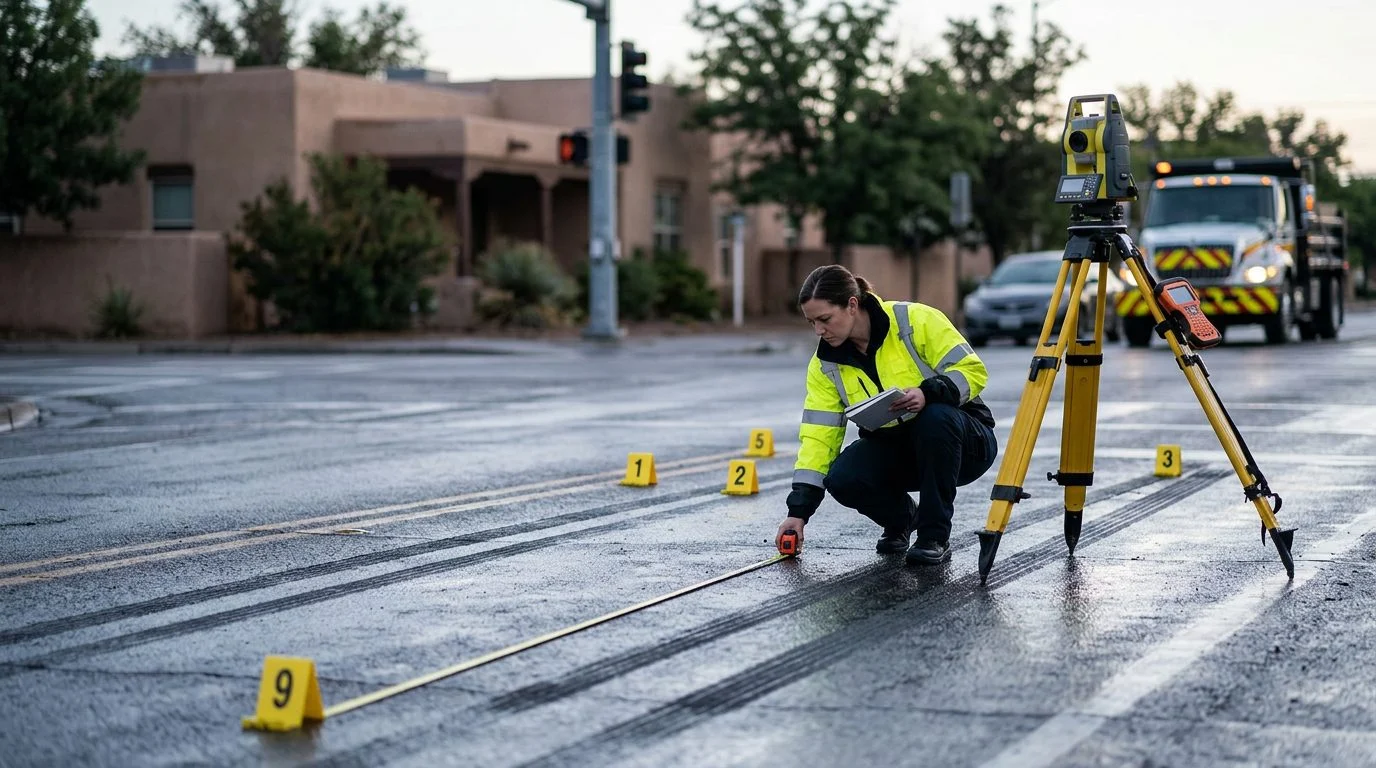
Truck crashes often involve more than one party. The truck driver, the company that operates the truck, and other drivers may each be part of the fault discussion. Investigators and insurers look closely at how the collision happened.
Traffic statutes give fault questions a starting point. Under NMSA § 66-7-318, the driver of a motor truck or motor vehicle drawing another vehicle may not follow another motor truck or motor vehicle drawing another vehicle within three hundred feet when traveling outside a business or residence district, except that this does not prevent overtaking and passing any like vehicle or other vehicle. Under NMSA § 66-7-317, where a roadway has been divided into two or more clearly marked lanes for traffic, a vehicle shall be driven as nearly as practicable entirely within a single lane. Under NMSA § 66-7-301, in every event, speed shall be so controlled by the driver as may be necessary to avoid colliding with a person, vehicle or other conveyance on or entering the highway.
These rules set out what drivers must do. Your own conduct also gets examined, including braking, signaling, and lane position. How all of these facts line up is what shapes the percentages.
What role do insurance companies play in comparative negligence claims?
An insurance adjuster may suggest a fault percentage early in a claim. An early split may favor the insurer’s side, so treat it as a starting position, not a final answer.
You may hear requests for a recorded statement or a quick settlement offer. Before you respond, it helps to understand how fault affects what you can recover. Take your time. Asking for the request in writing can help you think it through.
Keep records from the start. Save photos of the vehicles, the road, and the scene. Write down the police report number, witness names, and contact details. Keep medical records and bills. Make a short note of what each person said after the crash, and log the date of every call with an adjuster.
Fault disputes often get settled through negotiation. When talks stall, the dispute may move into the court system, which the next section explains.
Who decides who is at fault for a truck crash in New Mexico?
Fault can come up in settlement talks between the injured person’s side and the insurers. If the claim does not settle, a judge or jury may decide the percentages after hearing the evidence.
Police reports are one kind of evidence, but they are not the final word. With listed exceptions, no accident report may be used as evidence in any trial arising from the accident.
Claims against insurers follow a sequence. In Hovet v. Allstate (2004), the New Mexico Supreme Court held that a claim against an at-fault driver’s insurer for unfair settlement practices may be filed only after the underlying negligence case ends. That case must end with a judicial determination of fault in favor of the third party and against the insured.
Filing deadlines also apply in New Mexico, so timing matters. Early attention to the facts can help you keep your options open.
Not sure what your next step is?
Talk it through with our team — the first consultation is free, confidential, and carries no obligation.

Talk with El Gringo Law about your truck crash and fault questions
A truck crash is not something you chose. You may be hurting, a family member may still be recovering, and an adjuster may be waiting on an answer you are not sure how to give.
If you want to talk through the facts of your crash, El Gringo Law offers a free, confidential initial consultation with no obligation to continue.
Josh Wood is the responsible lawyer for this page. You can reach El Gringo Law through the contact form or at elgringolaw.com.
Quick answers
Can I recover if I was partly at fault in New Mexico?
Yes. Partial fault generally reduces damages by your percentage rather than barring them.
Does a police report decide fault?
No. A police report does not decide fault on its own, and it generally cannot be used as evidence at trial.
How El Gringo Law Can Help
Plain-Language Answers
We explain how shared fault questions work in a truck accident case, without legal jargon.
Focused on Injury Cases
Our practice focuses on car and truck accident claims and other serious injury matters.
Confidential Conversations
Your first consultation is free, confidential and comes with no obligation to continue.
Clear Next Steps
Our team will walk you through your options so you can decide what makes sense for you.
Be Careful What You Say About Fault
Comments made at the scene, in text messages or in early calls with insurance companies can be used later when fault is discussed. A free, confidential consultation can help you think through what to say and what to hold back.
Steps to Take After a Truck Crash
Document the Scene
Write down what you remember, including the time, weather, road conditions and where vehicles came to rest.
Keep Your Records
Save photos, medical bills, appointment notes and any letters you receive about the crash.
Get Your Questions Answered
Bring your questions to a free, confidential consultation with El Gringo Law to understand your situation.