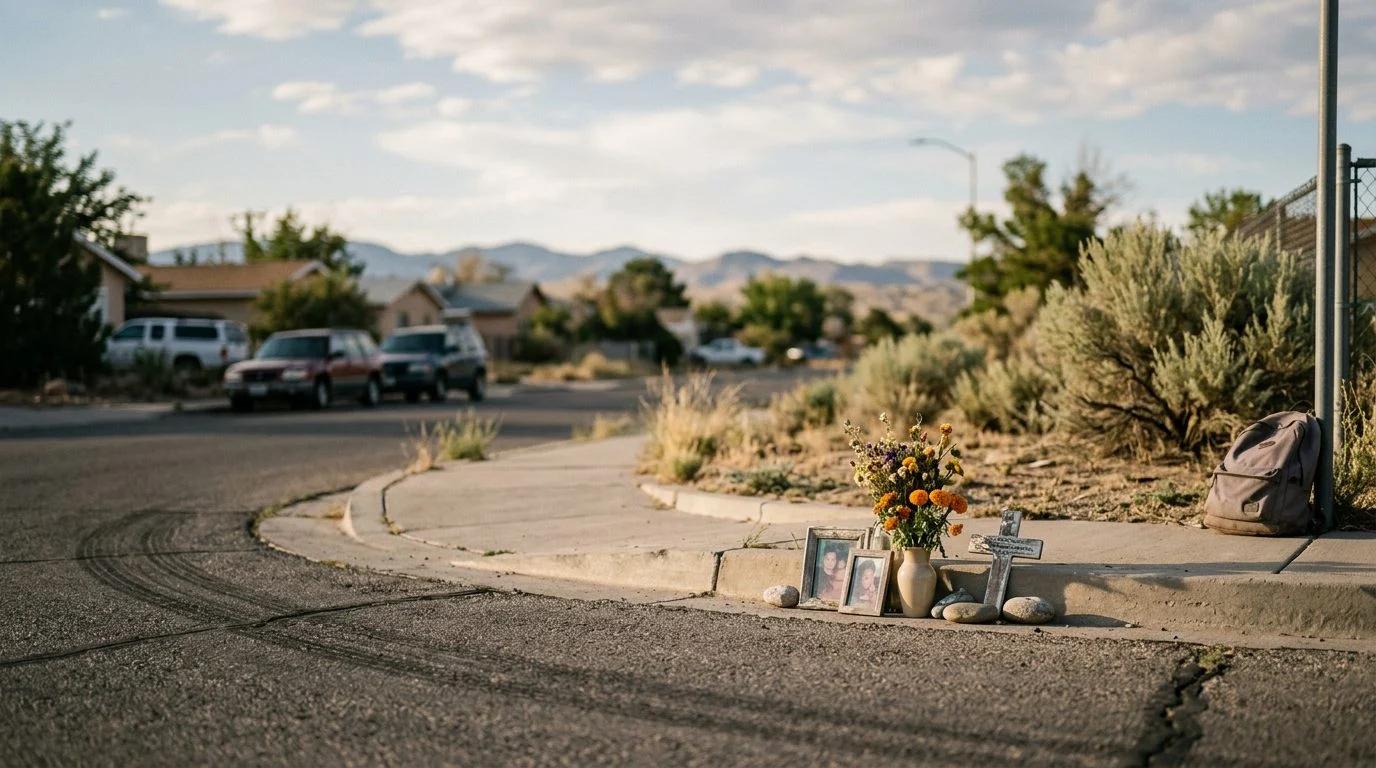
Wrongful Death · Bernalillo County, New Mexico
A Hit-and-Run Took Your Loved One. You Still Have Options.
When the driver leaves the scene, grieving families face unanswered questions and hard decisions. El Gringo Law helps New Mexico families understand their options after a hit-and-run death.
By Josh Wood · Published October 31, 2026
Yes, a family can still have options when the driver who caused a death is never found. New Mexico law lets a family bring a wrongful death claim when another person’s wrongful act causes a death. Your family’s own insurance may also help. This guide explains the hit and run death Albuquerque family options that usually come up first, in plain terms. Every case is different, and nothing here predicts how any case will turn out.
Your family may still have options when the driver is not found
Yes. A family can still pursue options even when the driver has not been identified or caught. The first days after a crash are hard. Families often face police questions, insurance calls and funeral plans all at once.
State law sets clear duties for drivers. A driver in a crash that causes injury or death, or total property damage of an apparent $500 or more, must send a written report of the crash to the department of transportation within five days. Under Section 66-7-203, the driver of any vehicle involved in an accident resulting in injury to or death of any person, or damage to any vehicle driven or attended by any person, must give his or her name, address and the registration number of the vehicle being driven. On request, the driver must show a driver’s license to the person struck or to the driver, occupant or attendant of any vehicle collided with. The driver must also give any person injured reasonable assistance, including carrying the injured person, or arranging for that person to be carried, to a physician, surgeon or hospital if treatment is apparently necessary or if the injured person requests it. The driver of any vehicle involved in an accident resulting in injury to or death of any person or damage to any vehicle which is driven or attended by any person shall give his name, address and the registration number of the vehicle he is driving and shall upon request exhibit his driver’s license to the person struck or the driver or occupant of or person attending any vehicle collided with and shall render to any person injured in such accident reasonable assistance, including the carrying, or the making of arrangements for the carrying, of such person to a physician, surgeon or hospital for medical or surgical treatment if it is apparent that such treatment is necessary or if such carrying is requested by the injured person (NMSA § 66-7-203).
A hit-and-run does not erase the basic wrongful death rule. Under Section 41-2-1, when a person’s death is caused by the wrongful act, neglect or default of another, even under circumstances that amount in law to a felony, and that act, neglect or default would have entitled the injured party to sue and recover damages had death not ensued, the person or corporation that would have been liable if death had not ensued is liable to an action for damages, notwithstanding the death of the person injured. The driver’s flight matters, but the family’s options turn on the facts that follow.
If the driver who left the scene of your loved one's crash is still unknown, you don't have to sort out the insurance and police questions alone. Our team is ready to talk with you. Talk it through with our team — the first consultation is free, confidential, and carries no obligation.
Uninsured motorist coverage: the family’s own policy
Uninsured motorist (UM) coverage on an auto policy may apply when the at-fault driver cannot be identified or has no insurance. New Mexico auto liability policies may include uninsured motorist (UM) coverage, which the policyholder can select or reject. That coverage protects people who are legally entitled to recover damages from an uninsured driver, including damages from a death.
Start with the declarations page of the policy the deceased person or household had. Check whether UM coverage was selected or rejected, and what limits apply. A relative’s policy or a policy covering the vehicle involved may also matter.
Each policy sets its own claim steps. Ask the insurer what proof it needs, such as a police report or other evidence of the hit-and-run. Report the crash to the insurer promptly.
A wrongful death claim against the driver or other responsible parties
New Mexico’s Wrongful Death Act lets a claim be brought when a death is caused by another’s wrongful act, neglect or default. Under NMSA § 41-2-1, when the death of a person is caused by the wrongful act, neglect or default of another, the person or corporation which would have been liable if death had not ensued shall be liable to an action for damages, notwithstanding the death of the person injured. Under NMSA 1978 § 41-2-3, every such action must be brought by and in the name of the personal representative of the deceased person.
The jury may award compensatory and exemplary damages. It considers the money-related loss from the death to the survivor entitled to the judgment. It also weighs the circumstances that made the wrongful act worse or less serious (§ 41-2-3). Proceeds are not liable for the deceased person’s debts, provided the decedent has left a spouse, child, father, mother, brother, sister or child or children of the deceased child, as defined in the New Mexico Probate Code. They go to survivors in a set order: to a surviving spouse when there is no child; one-half to the spouse and one-half to the children and grandchildren when there are both, with grandchildren taking by right of representation; to the children and grandchildren by right of representation when there is no spouse; to the father and mother equally, or to the survivor of them, when the deceased is a minor, childless and unmarried; to a surviving brother or sister when there is no father, mother, spouse, child or grandchild; and otherwise as the law provides for the personal property of deceased persons.
Loss of consortium damages (the loss of a close family relationship) belong to the family member who had that relationship. As the New Mexico Supreme Court explained in Thompson v. City of Albuquerque, loss of consortium damages result from the wrongful injury or death of someone who was in a sufficiently close relationship to the claimant, and those damages belong to the loss of consortium claimant rather than to the injured person or the decedent’s estate.
A claim against an unidentified driver is limited. The claim may change if the driver is later identified. It may also turn on whether another party shares responsibility, such as a property owner whose negligence contributed to the crash. In Herrera v. Quality Pontiac, the court stated that a negligence claim generally requires a duty owed by a defendant to a plaintiff, a breach of that duty (typically measured against a standard of reasonable care), and that breach being both a proximate cause and a cause in fact of the plaintiff’s damages.
Evidence to ask about: the Albuquerque police report, witnesses and camera footage
The police crash report is a key starting point. Ask the Albuquerque Police Department for the report and its case or report number. Under § 66-7-207(C), a law enforcement officer who investigates a motor vehicle accident of a kind that requires a report must forward a written report of the accident to the department of transportation within twenty-four hours after completing the investigation (§ 66-7-207). Ask for updates while the investigation is open.
It also says a report generally cannot be used as evidence in a trial arising from the accident (§ 66-7-213). In an arbitration or civil lawsuit over an insurer’s liability under a policy with uninsured motorist coverage, a copy of the investigating officer’s report that the investigating agency has officially authenticated may be offered as evidence to prove that the owner or operator of the other motor vehicle involved in the crash is either insured or uninsured. On request, the investigating agency must furnish an official copy of the investigating officer’s accident report to either party to the arbitration or civil action, or to the court.
Other evidence families often ask about includes:
- 911 call records
- Witness names and contact details
- Tips the police received
- Vehicle debris and paint transfer
- Any description of the vehicle or its damage
Video matters too. Nearby businesses, traffic cameras, home doorbell cameras and vehicle systems may record a crash. Many systems record over old footage, so early questions matter.
Why acting quickly matters
Acting early matters because evidence can disappear and key dates start running. Video can be overwritten. Witnesses may move or forget details. Debris can be cleaned up. These are reasons to plan now, not predictions about any case.
New Mexico gives three years to bring a wrongful death action (NMSA 1978, § 41-2-2 — three years from the date of death). Under Section 41-2-2 of the New Mexico statutes, a wrongful death action must be brought within three years, and that period is counted from the date of death (NMSA 1978, § 41-2-2 — three years from the date of death). The clock starts on the date of death, not on the date the family learns more about the crash.
Your own policy may set notice rules too, so ask your insurer early. Which deadlines apply depends on the facts of the crash and who may be responsible.
Questions families often ask after a hit-and-run death
Can we still file a claim if the driver is never found?
Possibly. Your family may have UM coverage on its own policy, and a wrongful death claim may be possible, depending on the facts.
Who can bring a wrongful death claim in New Mexico?
The claim is brought in the name of the personal representative.
Do we need to speak with the insurance company?
You may speak with your own insurer about your policy. Before you give a detailed statement about the crash, reach out to our team first so we can talk through your questions.
Should we keep the vehicle, phone or clothing?
Yes, keep physical items and records from the crash when you can. That includes the victim’s phone, messages and any tips your family received.
Not sure what your next step is?
Talk it through with our team — the first consultation is free, confidential, and carries no obligation.
Talk with Josh Wood about your family’s situation
Losing someone in a crash is hard enough. Add an open police investigation, insurance questions and a possible claim, and the choices can feel overwhelming. If your family is facing those decisions in Albuquerque or Bernalillo County, we invite you to reach out. You can contact El Gringo Law by phone, through the contact form at elgringolaw.com/contact, or by chat. The initial consultation is free, confidential and comes with no obligation to continue.
Josh Wood is the responsible lawyer for this page. He is licensed in New Mexico and Arizona. You can reach El Gringo Law through elgringolaw.com.
How El Gringo Law can help your family
Reviewing the facts
We look at what happened, where it happened and what evidence may still exist, so your family understands the situation before making decisions.
Checking your family's own insurance
We review your family's auto policy for uninsured motorist coverage, which may apply when the at-fault driver cannot be identified.
Handling the wrongful death claim
Our team focuses on wrongful death and car accident cases and helps the family pursue the claim while you focus on each other.
Respectful, straightforward communication
Our team explains each step in plain language and answers your questions, including questions about the claim process.
Before you speak with an insurance company
Insurance adjusters may ask for a recorded statement soon after a loss. It can help to speak with a lawyer before giving any statement about the crash or your loved one's injuries.
Practical steps while you decide what to do
Write down what you remember
Note the time, location, vehicle details and any witnesses while the memory is fresh. Keep any police report numbers you receive.
Keep records together
Save photos, messages, medical and funeral records, and documents from the scene in one place so they are easy to share with your lawyer.
Look at your own coverage
Find the auto insurance declarations page for your household. Our team can help you understand what it says about uninsured motorist coverage.
Ask your questions in confidence
Your first consultation is free, confidential and comes with no obligation to continue. Bring your questions and we will listen.
Your family does not have to sort this out alone
Related practice areas
- Wrongful Death Lawyers in New Mexico | El Gringo Law
- Wrongful Death in Bernalillo County
- Wrongful Death Claim Weeks After a New Mexico Crash