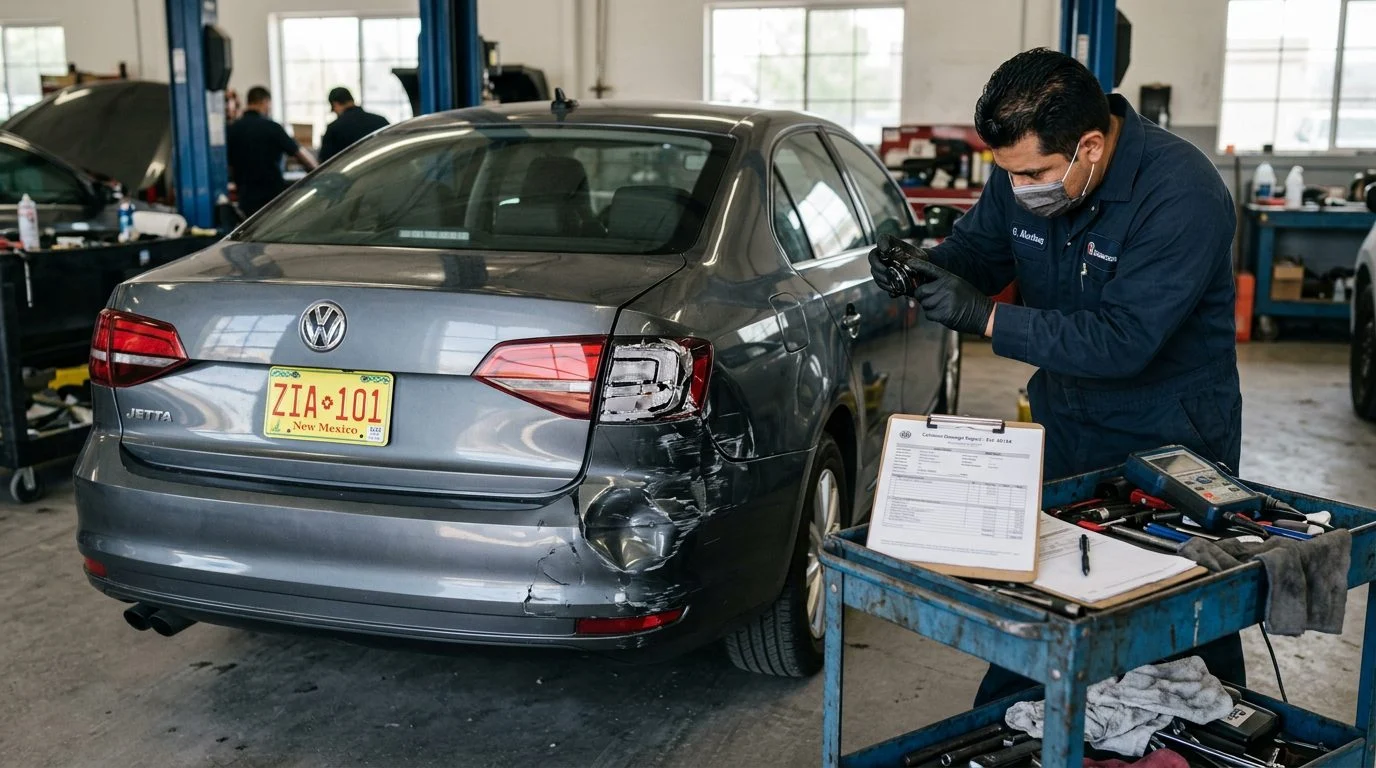
Car Accidents in New Mexico
Hurt in a Car Accident? Know Your Next Steps.
Plain-language guidance on fault, reporting and the first decisions that matter. Start with a free, confidential first consultation, with no obligation to continue.
By Josh Wood · Published November 1, 2026
Car accidents in New Mexico can leave you hurt, unable to work, and dealing with insurance companies at the same time. New Mexico law sets clear duties right after a crash and firm time limits for a claim. This guide explains those rules in plain language, from the scene to the deadlines that matter most. It is general information, and every case is different. Past results do not predict a similar outcome.
What to Do Right After a Car Accident in New Mexico
Your first steps after a crash are safety and a check for injuries. Move the vehicles out of traffic if you can do it safely, and turn on your hazard lights. Check yourself and everyone else for injuries before you do anything else.
Warn oncoming traffic if a disabled vehicle is blocking a lane. Stay clear of debris and spilled fluids on the road, because they can cause a second crash. If a vehicle may be leaking fuel or a hazardous material is involved, move away from it and call 911.
New Mexico law also requires drivers to stop. Under NMSA § 66-7-201, a driver in a crash that causes injury or death must immediately stop the vehicle at the scene or as close thereto as possible, then return to and remain at the scene until the requirements of NMSA 1978, § 66-7-203 are fulfilled. Fire and police crews often respond to serious crashes, so expect them.
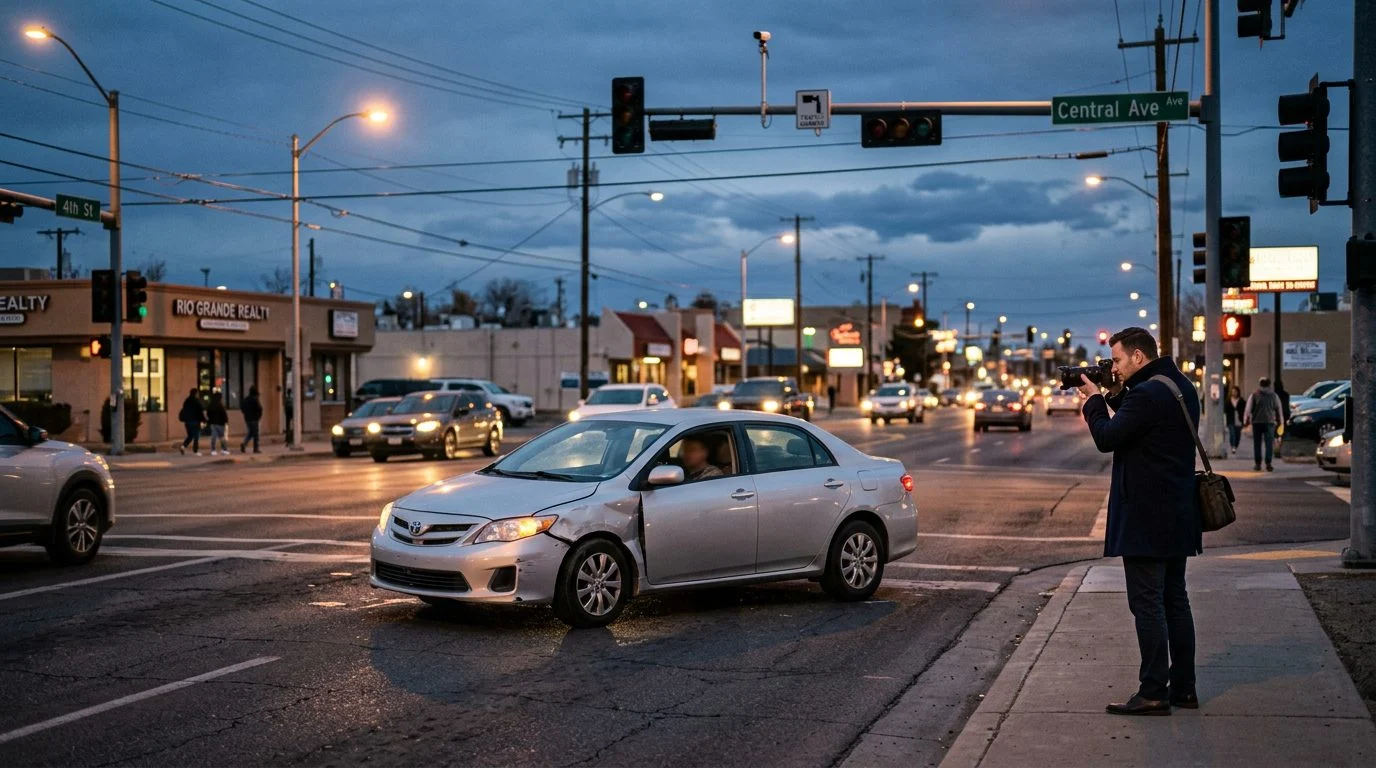
Take photos of the vehicles, the road, traffic signals, and any visible injuries. Get the other driver’s name, insurance details, and the names of any witnesses. Keep your statements short and factual at the scene.
If you were hurt in a crash and you're weighing a symptom that's just starting, an insurance offer, or a deadline, our team is ready to talk it through with you. Talk it through with our team — the first consultation is free, confidential, and carries no obligation.

Reporting the Crash and Keeping the Evidence
A crash that causes injury, death, or $500 or more in damage must be reported to police right away. Under NMSA § 66-7-206, the notice goes to the police department inside a city or town. Outside a municipality, it goes to the county sheriff or the nearest New Mexico State Police office.
NMSA § 66-7-207 also requires a driver involved in an accident resulting in bodily injury to or death of any person, or total property damage of $500 or more, to send a written report to the Department of Transportation within five days after the accident. Officers have their own reporting duties, but the driver’s report is still your job.
Evidence can disappear fast, so start collecting it early:
- Photos of the damage, the scene, and the road
- Dashcam footage or traffic camera video, if it exists
- Repair estimates and records of vehicle damage
- Names and statements from witnesses
Don’t wait to request footage, because recordings are often overwritten.
Section 66-7-207 does not set a stop-and-stay duty; it requires the driver of a vehicle involved in a qualifying accident to forward a written report of the accident to the department of transportation within five days. Under § 66-7-201, a driver who fails to stop where great bodily harm or death results is guilty of a fourth degree felony. A driver who knowingly fails to stop in that situation is guilty of a third degree felony.
Medical Care and Delayed Symptoms After a Crash
Getting checked by a medical provider after a crash protects your health and creates a record of your injuries. Some injuries don’t show up right away. Many people feel shaken but okay on the day of the crash, then notice pain, stiffness, or headaches days later.
Waiting can cause problems. A long gap between the crash and your first visit can make it harder to tie your treatment to the crash. Insurers may ask about gaps in care, so keep your appointments and follow your treatment plan.
Tell every provider how the crash happened and what hurts. Keep a simple log of new symptoms, missed work days, rides to appointments, and out-of-pocket costs. Save every bill, prescription receipt, and discharge paper. These records show how the injury affects your daily life.
Who Can Be Liable and How Fault Is Shared in New Mexico
Generally, a claim seeks payment from the person whose negligence caused the crash and that person’s insurer. A negligence claim generally requires a duty owed by the defendant, a breach of that duty, and a breach that was a cause of your damages, per Herrera v. Quality Pontiac.
Other people may share responsibility too. A vehicle owner may be liable for negligent entrustment if the owner gave a vehicle to a driver the owner knew or should have known was incompetent, and that incompetence caused the injury, per DeMatteo v. Simon.
New Mexico uses pure comparative negligence. Under Scott v. Rizzo, a plaintiff suing in negligence is no longer totally barred from recovery because of their own fault. Under the jury instruction in UJI 13-2218 NMRA, where comparative negligence is an issue, the case goes to the jury on a general verdict without special interrogatories, and there is no apportionment of negligence among defendants or non-parties, the total damages are reduced by the plaintiff’s percentage of negligence.
Many defendants are liable only for their own share. Under NMSA § 41-3A-1, a defendant is generally liable only for its portion of fault. Some exceptions apply, such as intentional injury and certain situations where one person is responsible for another’s acts.
New Mexico Insurance Minimums and Uninsured Driver Coverage
New Mexico sets minimum liability amounts for drivers. Under NMSA § 66-5-208, the amounts are $25,000 for injury or death of one person in one accident. Section 66-5-208 of the New Mexico Statutes states that “evidence of financial responsibility,” as used in the Mandatory Financial Responsibility Act, means evidence of the ability to respond in damages for liability, on account of accidents occurring after the effective date of the evidence, arising out of the ownership, maintenance or use of a vehicle of a type subject to registration under New Mexico law, in these amounts: twenty-five thousand dollars ($25,000) because of bodily injury to or death of one person in any one accident; subject to that limit for one person, fifty thousand dollars ($50,000) because of bodily injury to or death of two or more persons in any one accident; ten thousand dollars ($10,000) because of injury to or destruction of property of others in any one accident; and, if the evidence is in the form of a surety bond or a cash deposit, a total amount of sixty thousand dollars ($60,000). Those amounts can fall short of the cost of a serious injury, so check your own policy and the at-fault driver’s policy.
Under NMSA § 66-5-301, auto liability policies delivered in New Mexico for vehicles registered or principally garaged in New Mexico must include uninsured motorist coverage. NMSA 1978, § 66-5-301(A) requires that motor vehicle liability policies delivered or issued in New Mexico for vehicles registered or principally garaged in the state include uninsured motorist coverage, in at least the minimum limits set out in § 66-5-215 and in any higher limits the insured desires, up to the liability limits in the insured’s policy, for persons legally entitled to recover damages from owners or operators of uninsured motor vehicles. That coverage also includes underinsured motorist coverage. Under New Mexico’s uninsured motorist statute, Section 66-5-301, the named insured has the right to reject uninsured motorist coverage as described in Subsections A and B; unless the named insured requests that coverage in writing, it need not be provided in a renewal policy when the named insured rejected it on a policy previously issued by the same insurer.
Rideshare crashes follow different rules. Under NMSA § 65-7-8, coverage amounts depend on whether the driver is logged on to the app or on a prearranged ride. During a prearranged ride, at least $1,000,000 in primary liability coverage applies.
Deadlines: Statute of Limitations and Notice Rules
A personal injury claim generally must be brought within three years, under NMSA § 37-1-8. A wrongful death action must be brought within three years after the cause of action accrues, which is the date of death, under NMSA § 41-2-2. Which deadline applies depends on the facts, so check timing early.
Government defendants have a shorter notice rule. That period does not include up to 90 days during which the injured person is incapacitated by the injury from giving notice, and the notice requirement does not apply if the governmental entity already had actual notice of the occurrence, per NMSA § 41-4-16. For a wrongful death claim against such an entity, notice may be presented within six months after the injury that caused the death.
Missing a deadline can end a claim, and that is hard to fix later. Other claims, such as some property damage claims, may follow different time limits. Ask about every deadline that might apply to your crash.
Not sure what your next step is?
Talk it through with our team — the first consultation is free, confidential, and carries no obligation.
Dealing With the Insurance Adjuster and First Offers
The other driver’s insurer works to limit what it pays. Its adjuster may ask for a recorded statement early. Before you agree, write down the facts you know. Stick to what you saw and felt, and avoid guessing about speed, distance, or fault.
Early offers often arrive before the full extent of an injury is known. A quick offer may not account for future treatment, time off work, or symptoms that keep going. Read any document carefully before you sign it.
New Mexico’s unfair claims practices law lists claim-handling practices that an insurer or other person may not knowingly commit with such frequency as to indicate a general business practice. Under NMSA § 59A-16-20, not attempting in good faith to effectuate prompt, fair and equitable settlements of an insured’s claims in which liability has become reasonably clear is an unfair and deceptive practice when knowingly committed or performed with such frequency as to indicate a general business practice. A third-party suit against the at-fault driver’s insurer can be filed only after the underlying negligence case ends with a judicial finding of fault against the insured, per Hovet v. Allstate Insurance Co..
What a Car Accident Claim May Recover
A car accident claim can seek economic losses and non-economic losses. Economic losses are costs you can count, such as medical bills, lost wages, rental car costs, and vehicle repair. Loss of use and diminished value may also be part of a claim, depending on the facts.
Non-economic losses include pain and suffering and the loss of everyday activities you once enjoyed. These losses are harder to measure than bills, but they are real and can be part of your claim.
A spouse or other close family member may have a loss of consortium claim. Under Thompson v. City of Albuquerque, those damages belong to the family member, not to the injured person or the decedent’s estate.
How much a claim is worth depends on the injuries, the evidence, and the facts of the crash. Every case is different, and past results do not indicate a similar outcome.
Car Accident Coverage Across New Mexico
Every crash has its own facts, whether it happens in Albuquerque, Rio Rancho, Santa Fe, Las Cruces, Taos, or Farmington. Crashes in Bernalillo County, Sandoval County, and other parts of New Mexico each have their own facts and circumstances.
Interstate traffic moves through many of these areas, including I-25 and I-40. Highway crashes often involve high speeds and multiple vehicles, which makes the crash report and the photos especially important.
Each crash type raises its own evidence questions. Intersection and left-turn crashes often turn on signal timing and vehicle position. Rear-end crashes raise questions about following distance and braking. Pedestrian crashes often depend on where the person was when they were struck. The Insurance Institute for Highway Safety publishes state-by-state fatality facts, including alcohol and seat-belt factors.
Fees, Costs and Your Free First Consultation
The first consultation with El Gringo Law is a free, confidential meeting with no obligation to continue.
In that conversation, you describe what happened, your injuries, and any contact you’ve had with insurers so far. Bring what you have, such as the crash report, medical bills, photos, and letters from insurers. The firm reviews the facts with you and explains the options that may apply to your situation. You decide what to do next.
Talk With Josh Wood About Your Car Accident
Josh Wood is the responsible lawyer for the content on this page. He is licensed in New Mexico and Arizona, and this page is published by El Gringo Law.
What should I do first after a car accident in New Mexico?
Check everyone for injuries and move to safety if you can. Then make the reports New Mexico law requires.
How long do I have to file a car accident injury claim in New Mexico?
A personal injury claim generally must be brought within three years. Government defendants can have a shorter 90-day written notice rule.
Does New Mexico reduce damages if I was partly at fault?
Yes, your damages are reduced by your percentage of fault. You are not totally barred from recovery because of partial fault.
What are New Mexico’s minimum car insurance limits?
The minimums are $25,000 per person and $50,000 per accident for two or more people. The property damage minimum is $10,000.
If you were hurt in a crash and you’re weighing a symptom that’s just starting, an insurance offer, or a deadline, you can reach out through our contact form and talk it through.
How El Gringo Law Helps After a Crash
We review the crash facts
We look at the police report, photos, medical records and insurance correspondence to understand what happened and what it means for you.
We stand up for you
When insurance companies make quick offers or ask for recorded statements, we handle the communication so you can focus on recovering.
We keep you informed
Our team explains each step in plain English and answers your questions as your case moves forward.
You can reach us your way
Call, send a contact form or start a chat. Our team is ready to talk about your situation.
Before You Talk to the Insurance Company
Adjusters are trained to gather information that can limit your claim. Before you give a recorded statement, sign a release or accept an offer, talk with a lawyer about what you are being asked to do.
Common Car Accident Situations We Handle
Rear-end and intersection crashes
Collisions at stoplights, intersections and merges often involve disputed facts. We help organize the evidence that tells the story.
Crashes involving commercial trucks
Accidents with big rigs and other commercial vehicles can involve more parties and more complex records. We help you understand who may be involved.
Hit-and-run collisions
When the other driver leaves the scene, the path to recovery can be harder. Our team looks at every available lead to identify the facts.
Injuries that change your life
Serious injuries, including spinal cord injuries, amputations and burns, need careful attention to medical and financial impacts.