
Car Accidents | New Mexico
After a Catastrophic Car Accident in New Mexico, Start With Your Health and the Facts
El Gringo Law represents people hurt in serious crashes across New Mexico. Here is what to focus on in the days that follow, and how our team can help. Your first consultation is free, confidential, and comes with no obligation to continue.
By Josh Wood · Published November 3, 2026
If you are asking what to do after a catastrophic car accident in New Mexico, start with medical care. Then protect the facts of the crash, report it correctly, and keep careful records. A catastrophic injury, such as spinal cord damage, an amputation, a severe burn, or a brain injury, can change your health, work, and home life for a long time. The steps below follow the order that matters most. They apply whether you were driving, riding as a passenger, walking, or acting for a family member who was hurt. Each step protects something you may need later.
What Makes a Car Accident Catastrophic
A crash is catastrophic when the injury is severe and its effects last for months or years. Common examples include spinal cord injuries, amputations, severe burns, traumatic brain injuries, and multiple fractures that limit movement or work. These injuries often involve hospital stays, surgery, and rehabilitation. They can also change how you earn a living or care for your family. Recovery can take a long time, and the full picture may not be clear for months. That is why the records and notes described below matter so much. The steps below apply to drivers, passengers, pedestrians, and family members who act for an injured person. For a broader overview of this practice area, read our catastrophic injuries guide.
If a serious crash has left you or a family member facing long treatment and lost work, you don't have to sort out the next steps alone. Talk it through with our team — the first consultation is free, confidential, and carries no obligation.

First Steps: Medical Care and Safety at the Scene
Your first priority is medical care, so get checked even if you feel you are okay. Some serious injuries are not obvious right after a crash, and symptoms can grow over hours or days. Follow every treatment recommendation and keep your appointments. Gaps in care can be used by others to question how badly you were hurt. Tell your medical team about every symptom, even small ones.
New Mexico law requires a driver in an injury crash to stop at the scene and stay there. § 66-7-201 sets that rule.
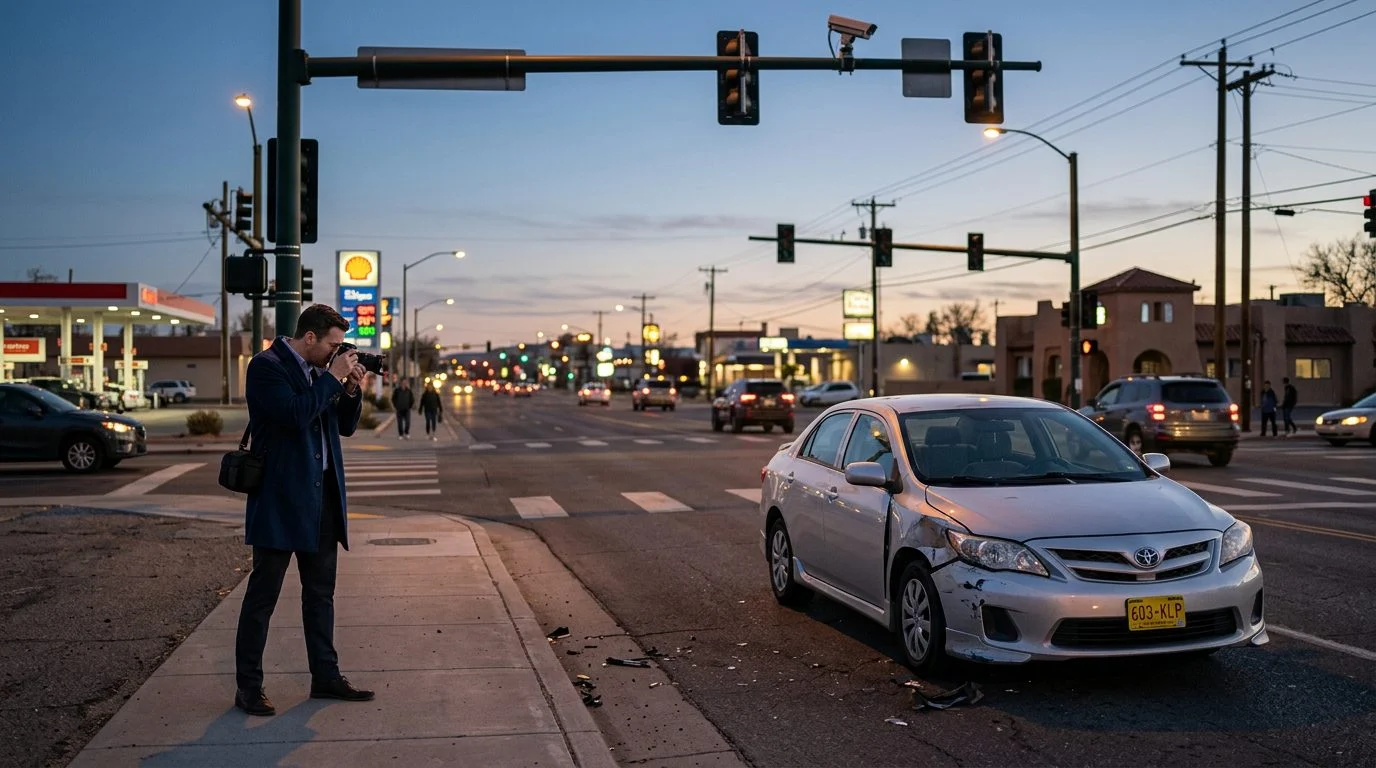
Call 911 if anyone is hurt. If you can move safely, get out of active traffic and turn on your hazard lights. Do not step into traffic to take photos or check on another vehicle. Your safety comes first. You can document the scene from the curb or the shoulder.
Document the Scene and Gather Evidence
Evidence from the scene is the hardest to rebuild once vehicles are moved. Take photos of vehicle positions, damage, skid marks, road conditions, traffic signals, and any visible injuries, from several angles. Get the other driver’s name, phone number, insurance details, and license plate. Write down the names and contact details of witnesses, including people who saw the crash but left before police arrived.
Write your own account while the details are fresh. Note the time, the weather, the direction of travel, and the order of events. Save texts, photos, and notes about the crash. Keep track of any dashcam footage or traffic camera references you can find.
The order of events matters. A proximate cause is a cause that, in a natural and continuous sequence, produces the injury. Under Herrera v. Quality Pontiac, a proximate cause need not be the only cause, the last cause, or the nearest one. Clear notes help show how the crash led to each injury.
Reporting the Crash and Finding Every Source of Recovery
Knowing what to do after a catastrophic car accident in New Mexico starts with a police report. Report the crash right away, and ask for the report number and the agency’s name. § 66-7-206 requires the driver to give immediate notice of a crash with injury or death, or with property damage of $500 or more. Notice goes to the police department inside a city. Otherwise, it goes to the county sheriff or the New Mexico State Police.
§ 66-7-207 also requires the driver to send a written report of the accident to the Department of Transportation within five days if the accident resulted in injury to or death of any person, or in apparent total property damage of $500 or more. Keep copies of everything you send or receive.
If the other driver left the scene, tell police at once. Write down any part of the license plate, the vehicle’s make and color, and its direction of travel. Note anything you remember about the driver. Hit-and-run crashes can be harder to prove, so every detail counts.
Next, list every possible source of payment. The at-fault driver’s liability policy may apply, and so may your own policy. Under § 66-5-301, New Mexico uninsured motorist coverage must include underinsured coverage for people protected by the policy. A crash with a commercial truck can involve more parties, such as the company that operates the truck.
Keep Medical Records and Expense Records
Keep every bill, record, and receipt from the first day. Save each explanation of benefits, prescription receipt, and mileage log for trips to appointments. Organize them by date in one folder, paper or digital. Request complete medical records from each provider, including emergency care, imaging, surgery notes, and therapy notes. Write down the names of the people who treat you and the dates they saw you.
Track time off work and any change in pay or job duties. Keep a daily journal of pain, sleep problems, and tasks you can no longer do alone. Bills alone may not show how an injury changes everyday life. A journal can.
Clear records make every claim easier to prove. They also help your medical team see how you are doing between visits. Family members who help can use the same folder and add notes from appointments they attend.
Dealing With Insurance Companies Carefully
Speak carefully with any insurance company. Its adjuster works for the insurer, not for you. Do not admit fault or guess about how the crash happened. Stick to facts you know for certain. A casual comment like “I think I was going too fast” can be repeated and used later.
New Mexico follows pure comparative negligence (shared fault). Under Scott v. Rizzo, a plaintiff is no longer totally barred from recovery because of their own fault. Under UJI 13-2218 NMRA, the jury reduces the damages by the injured person’s percentage of fault. That is why any statement about who caused the crash deserves care.
Be cautious with recorded statements. You can say you will follow up after you review your records. Do not sign medical authorizations, releases, or settlement papers until you understand what they cover. Read every document before you sign it.
Early offers may not account for future treatment, rehabilitation, or long-term limits. A catastrophic injury can take time to document fully. Taking time to see the full medical picture is often wise.
Not sure what your next step is?
Talk it through with our team — the first consultation is free, confidential, and carries no obligation.
New Mexico Deadlines You Should Know
For most personal injury claims, New Mexico generally allows three years to file a lawsuit. NMSA § 37-1-8 sets a three-year period for actions for an injury to the person or reputation of any person. It sets a two-year period for actions against sureties on official bonds and on bonds of guardians, conservators, personal representatives and persons acting in a fiduciary capacity, running from when the principal’s liability is finally established or determined by a judgment or decree of the court. Other claims can have different deadlines, and which deadline applies depends on the facts.
Claims against a government entity move faster. § 41-4-16(A) requires a written notice stating the time, place and circumstances of the injury within ninety days after the occurrence. Without notice, a suit against that government body cannot be maintained, unless the entity had actual notice of the occurrence. § 41-4-16(B) says so.
Actual notice has limits. Under Lopez v. State, actual notice counts only if the particular agency that caused the harm had actual notice. For a wrongful death claim against a government entity, § 41-4-16(C) allows notice within six months after the injury that caused the death.
Write the crash date down now. Set reminders for each deadline, and keep any notice paperwork with your other records.
Planning for Long-Term Care and Costs
Catastrophic injuries often create future needs that the first bills don’t show. These can include surgery, rehabilitation therapy, assistive equipment, home modifications, and future medical care. A family that tracks only the bills received so far may miss costs that arrive months later.
Ask your treating team for a written list of expected future care. Note who recommended each item and when. Keep that list with your records. It gives a clearer picture of what the injury may require over time.
Close family members can have their own claims. Under Thompson v. City of Albuquerque, loss of consortium damages (losses tied to a close relationship) belong to the family member who claims them. They do not belong to the injured person or the decedent’s estate.
Frequently Asked Questions
What if the other driver left the scene?
Report it to police as soon as possible. Write down every detail you remember about the vehicle, including any part of the plate.
Do I have to report a crash to the state?
If the crash caused injury or death, or total property damage to an apparent extent of five hundred dollars ($500) or more, the driver must send a written report to the Department of Transportation within five days. § 66-7-207 sets that rule.
Should I talk to the other driver’s insurer first?
Limit what you say, avoid admitting fault, and do not sign anything you don’t fully understand.
Can a family member help someone who is hospitalized?
Family members can gather records, dates, and contact information for the injured person.
Talk With Josh Wood About Your Crash
Talk with Josh Wood about your crash, your injuries, and the steps ahead. A serious crash can bring long treatment, lost work, and changes at home, and the decisions in front of you can feel overwhelming. A conversation can help you sort out the records, deadlines, and insurance questions covered in this guide. Reach out by phone, through our contact form, or by starting a chat.
Your first consultation is free, confidential, and carries no obligation to continue.
Josh Wood is the responsible lawyer for this page. He is licensed in New Mexico and Arizona. You can learn more about El Gringo Law at elgringolaw.com.
Steps to take after a serious crash
Get medical care right away
Some serious injuries, including spinal cord injuries and burns, may not show their full extent for hours or days. Follow every recommendation from your medical providers and keep copies of your records.
Report the crash
Call the police and ask for a report. If the other driver left the scene, report it as soon as possible and write down every detail you remember about the vehicle, including any part of the license plate.
Document the scene
Photograph vehicles, road conditions, injuries, and any hazards. Collect names and contact information for witnesses. Save receipts and notes about missed work and daily limitations.
Talk with a lawyer before speaking to insurers
Insurance adjusters may ask for recorded statements or quick settlements. Speak with El Gringo Law before you give a statement or sign any paperwork.
Matters we handle
Car and trucking accidents
Collisions involving passenger vehicles, commercial trucks, and other large vehicles on New Mexico roads.
Catastrophic and life-changing injuries
Spinal cord injuries, amputations, burn injuries, and other injuries that affect work, independence, and family life.
Wrongful death
Support for families who have lost a loved one in a crash or in another preventable incident.
Premises liability and negligent security
Injuries caused by unsafe property conditions or inadequate security, handled with the same careful attention.
Key reminder
Do not give a recorded statement or sign a release from an insurance company until you have talked with a lawyer about your situation. Keep your medical appointments and avoid posting about the crash or your injuries on social media.