Spinal Cord Injury | New Mexico
Asked for a Recorded Statement After a Spinal Injury? Pause and Plan Your Next Step.
Before you speak with an insurance adjuster, know what to ask, what to hold back, and when to bring in a lawyer.
By Josh Wood · Published November 12, 2026
You were hurt in a car accident in New Mexico, and now the other driver’s insurance adjuster wants a recorded statement about the crash and your spinal injury. You can ask for time before you answer. You don’t have to decide on the phone, and a short pause is a reasonable step.
Short Answer: Can You Refuse or Delay a Recorded Statement?
Yes, you can ask to delay a recorded statement while you decide what to do next. The other driver’s insurer protects its own policyholder, so its interests can be opposed to yours.
Your own policy is a different relationship. Your own insurer may need its own notice, so treat that as a separate call.
You don’t need to answer every question on the spot. A simple “I’m not ready to discuss that yet” is a fair response for now. Whatever you say on a recording can be used to judge your claim, so treat the question as a decision, not a reflex.
If an adjuster has asked for a recorded statement while you're still recovering from a spinal injury, we can talk it through with you before you answer. Talk it through with our team — the first consultation is free, confidential, and carries no obligation.

What a Recorded Statement Is and How It Is Used
A recorded statement is a call in which an adjuster asks questions and records your answers for the claim file. The questions often sound friendly and routine. The adjuster may ask how you feel, what you did that morning, whether you went to work, or what you could lift last week.
Each answer becomes part of the file. Adjusters often compare what you say with the police report and your medical records. A short answer given in a hurry can later look like a contradiction, even when you meant something else.
New Mexico also limits this kind of contact early on. Under NMSA 1978, § 41-1-1, a person whose interest is adverse to an injured patient may not, within fifteen days of the occurrence, try to obtain a statement from that patient for a settlement or release. This applies when the patient is under the care of a licensed healing-arts provider or confined to a hospital.
A written statement given without the required notice and acknowledgement can be disavowed within fifteen days after the injured person is discharged from that care or released from the hospital, whichever occurs first. Such a written statement is not evidence in a later court action about the injury. So a recorded request in that window deserves a careful, informed answer.
Why Timing Matters After a Spinal Cord Injury
Timing matters because a spinal injury can change over days and weeks. Pain, numbness, weakness, or trouble walking may shift as your care goes on. What you feel today may not show the full picture.
Pain medication, shock, and tiredness can cloud memory in the first days after a crash. You may not recall exact times, speeds, or how a pain first started.
A statement given then can be read later as incomplete or inconsistent. A careful answer, given with your records in view, helps avoid gaps between what you said and what your doctors wrote. If you’re deciding whether to speak now or after more is known, the answer depends on what your providers have documented so far.
What Medical Records and Documents Matter in the Claim
The medical record is the core of any spinal injury claim, and it should match what you tell adjusters. Keep copies of the records that describe your injury. These include emergency and imaging reports, notes from treating doctors, rehabilitation records, and prescriptions. Keep work notes and bills too.
A consistent account across these documents supports the claim. An insurer may question gaps in treatment, so keep your appointments. Ask providers to write down new or changing symptoms.
A simple daily log of pain, sleep, and the tasks you could not do can help you remember details later. Bring it to every appointment.
For readers with longer-term needs, a life care plan after a spinal cord injury explains how future care is planned. For the local picture, see spinal cord injury claims in Bernalillo County.
Evidence From the Crash Scene That Supports the Claim
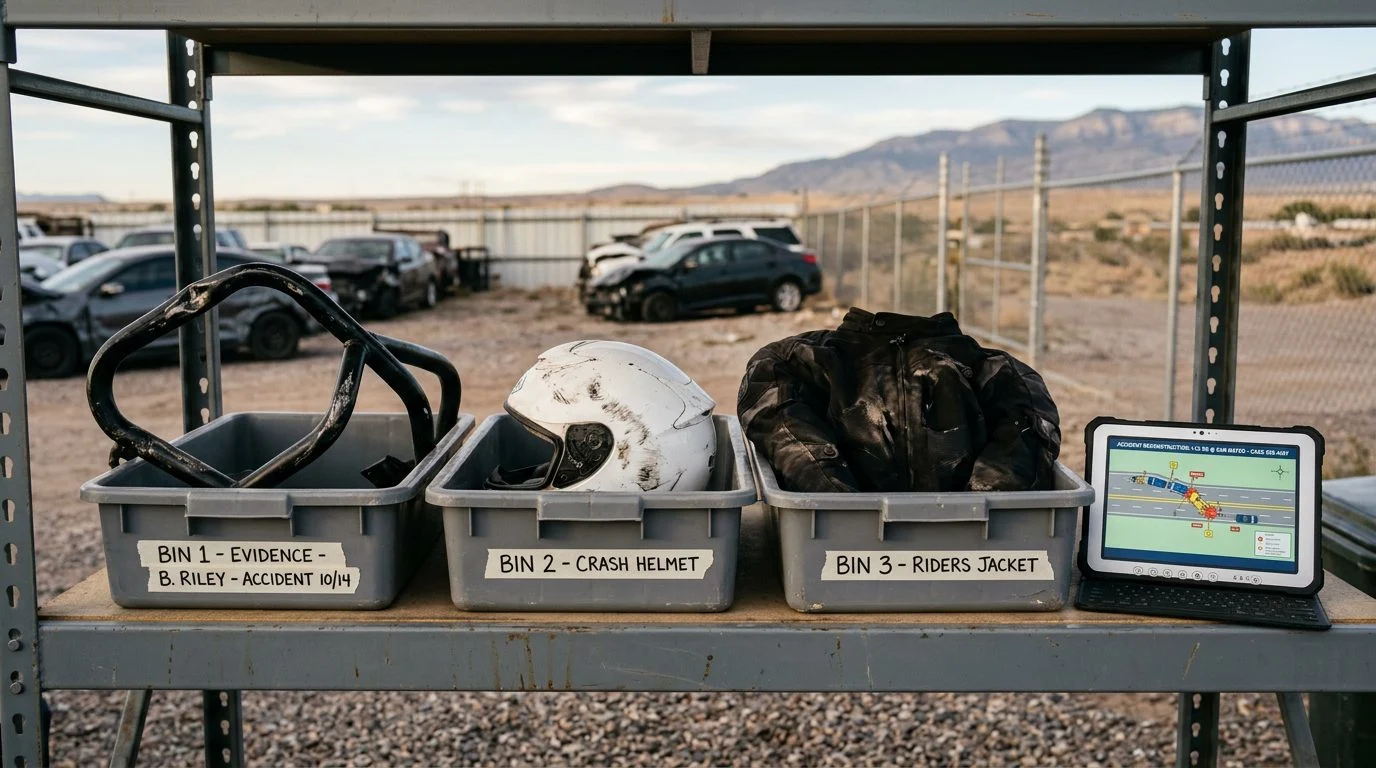
Evidence from the scene, like photos and the police report, can show how the crash happened without relying on memory alone. Photos of the vehicles, the scene, and your injuries help. So do the names of witnesses and the repair estimate for each car.
Under NMSA 1978, § 66-7-206, a driver in an accident resulting in bodily injury to or death of any person, or in property damage that appears to be $500 or more, must immediately, by the quickest means of communication, give notice to the police department if the crash is within a city or town, or otherwise to the county sheriff or the nearest New Mexico state police office. Under NMSA 1978, § 66-7-207, that driver must also send a written report to the department of transportation within five days.
It need not be the only cause. Herrera v. Quality Pontiac states that rule.
What to Do If an Adjuster Calls Before You Have Decided
Ask for the request in writing, and say you need time before you answer. A calm pause is a reasonable response.
Write down the adjuster’s name, company, and claim number before the call ends. Note the date and time too.
Don’t guess at dates, speeds, or details you are unsure of. Say “I don’t know” or “I need to check my records” instead.
Don’t describe your injury as minor or fully recovered while care is still going on. Don’t sign a release or settlement paper without reviewing it first.
Keep a copy of everything you send or receive, including emails and letters. Your own insurer may need a separate notice. That conversation is different from the other driver’s insurer’s request, so keep the two apart.
Not sure what your next step is?
Talk it through with our team — the first consultation is free, confidential, and carries no obligation.

Talk Through Your Situation Before Any Recorded Statement
If an adjuster has asked for a recorded statement while you’re still in treatment, you can talk it through with us first. You may be managing pain, medication, appointments, and a car that still needs repair. Deciding what to say on a recording is a lot to carry alone.
Our first consultation is free, confidential, and carries no obligation to continue.
Josh Wood is the responsible lawyer for this page at El Gringo Law. You can reach the firm by phone, through the contact form, or by chat. We represent people injured in New Mexico, including in Santa Fe.
Frequently Asked Questions
Do I have to give a recorded statement to the other driver’s insurer?
Whether you must answer depends on the facts of your claim. Ask for the request in writing and time to decide before you answer.
How long do I have to file an injury claim in New Mexico?
New Mexico generally allows three years for injury to a person, under NMSA 1978, § 37-1-8.
Why Talk With El Gringo Law First
Free first consultation
Our initial consultation is free, confidential, and carries no obligation to continue.
Focused on serious injury cases
We focus on car accidents, trucking accidents, catastrophic injuries, and spinal cord injuries across New Mexico.
Confidential from the first call
Tell us what happened and what you were asked. We will explain your options in plain language.
Clear paperwork and guidance
Our team helps you organize medical records, correspondence, and questions before any statement is given.
Warning: Do Not Guess on a Recorded Line
Spinal injuries can change over time. Do not describe your recovery, pain, or limitations from memory on a recorded call. Ask for the request in writing and time to decide.
Questions to Ask Before You Answer
Who is asking, and why?
Confirm the caller's name, company, and the claim number. Ask what the statement will be used for.
Can you request it in writing?
A written request lets you review the topics and decide with a clear record of what was asked.
Do you need time to decide?
Asking for time to review your situation is a normal step. Whether you must answer depends on the facts of your claim.
Should a lawyer be present?
A lawyer can speak with the insurer for you and help you decide what to say and when.