Wrongful Death | New Mexico
How Do You Prove a Wrongful Death Lawsuit in New Mexico?
Losing someone to another person's negligence is devastating. El Gringo Law helps families understand what proof looks like and how a case is built, one step at a time. Your free, confidential initial consultation comes with no obligation to continue.
By Josh Wood · Published November 8, 2026
To prove a wrongful death lawsuit in New Mexico, the family must show that another party’s wrongful act or neglect caused the death. This page explains each part in plain words and the proof that tends to support it. If you’re reading this while grieving, take it one step at a time.
What a Wrongful Death Claim Has to Show
A wrongful death claim lets a family seek damages after a person dies because of someone else’s wrongful act or neglect. Under the Wrongful Death Act, every action must be brought by and in the name of the personal representative of the deceased person.
Courts describe a negligence claim in core parts. The plaintiff must show a duty owed, a breach of that duty, and a breach that was a proximate cause and cause in fact of the damages. Herrera v. Quality Pontiac sets out that structure.
The evidence that matters most shifts with the type of incident, whether it’s a crash, a commercial truck collision, a dangerous property condition, or a violent attack that security should have guarded against.
If you're sorting through records after losing someone you love, our team can help you think through what to gather first and what it may mean for your family. Talk it through with our team — the first consultation is free, confidential, and carries no obligation.
Who Can Bring a Wrongful Death Claim in New Mexico
NMSA § 41-2-3 requires that every such action be brought by and in the name of the personal representative.
Find out early who holds that role. Keep any estate paperwork you already have, and write down who was handling the person’s affairs. Early clarity avoids confusion later.
The same statute sets who receives money from a judgment. The proceeds are not liable for the deceased’s debts, provided the decedent left a spouse, child, father, mother, brother, sister or child or children of the deceased child. Under NMSA § 41-2-3, the proceeds of a wrongful death judgment are distributed according to who survives: if there is a surviving spouse and no child, the spouse takes the proceeds; if there is a surviving spouse and a child or grandchild, one-half goes to the spouse and the remaining one-half goes to the children and grandchildren, with grandchildren taking by right of representation; if there is no spouse but a child or grandchild survives, the child and grandchild take by right of representation; if the decedent was a minor who was childless and unmarried, the father and mother take equal interests, or the surviving parent takes if one is dead; and if there is no father, mother, spouse, child or grandchild, a surviving brother or sister takes. If none of those relatives survive, the proceeds follow the rules for disposing of personal property.
Questions about adult children and more distant relatives need a close look at the family’s facts. Keep a list of who survived the person who died, with dates of birth and each person’s relationship.
Proving Fault: Duty of Care and Breach
Fault starts with a duty of care that the other party owed and then failed to meet. New Mexico’s uniform jury instructions say every person has a duty to use ordinary care for the safety of others (UJI 13-1604 NMRA).
The duty looks different in each type of case:
- Driving: A driver must use ordinary care on the road. UJI 13-1604 NMRA reads: “Every person has a duty to exercise ordinary care for the safety of the person and the property of others. [Every person also has a duty to exercise ordinary care for the person’s own safety and the safety of their property.] USE NOTES The bracketed material is to be used only when the party seeking recovery has been charged with lack of ordinary care.” A crash may show the driver did not.
- Trucking: A motor carrier must systematically inspect, repair, and maintain the vehicles it controls (49 C.F.R. § 396.3).
- Premises: An owner or occupant must use ordinary care to keep the premises safe for visitors (UJI 13-1309 NMRA).
- An owner or occupant must use ordinary care to keep the premises safe for visitors, and the duty to protect visitors arises from a foreseeable risk that a third person will injure a visitor (UJI 13-1320 NMRA).
Breach means conduct that falls short of reasonable care.
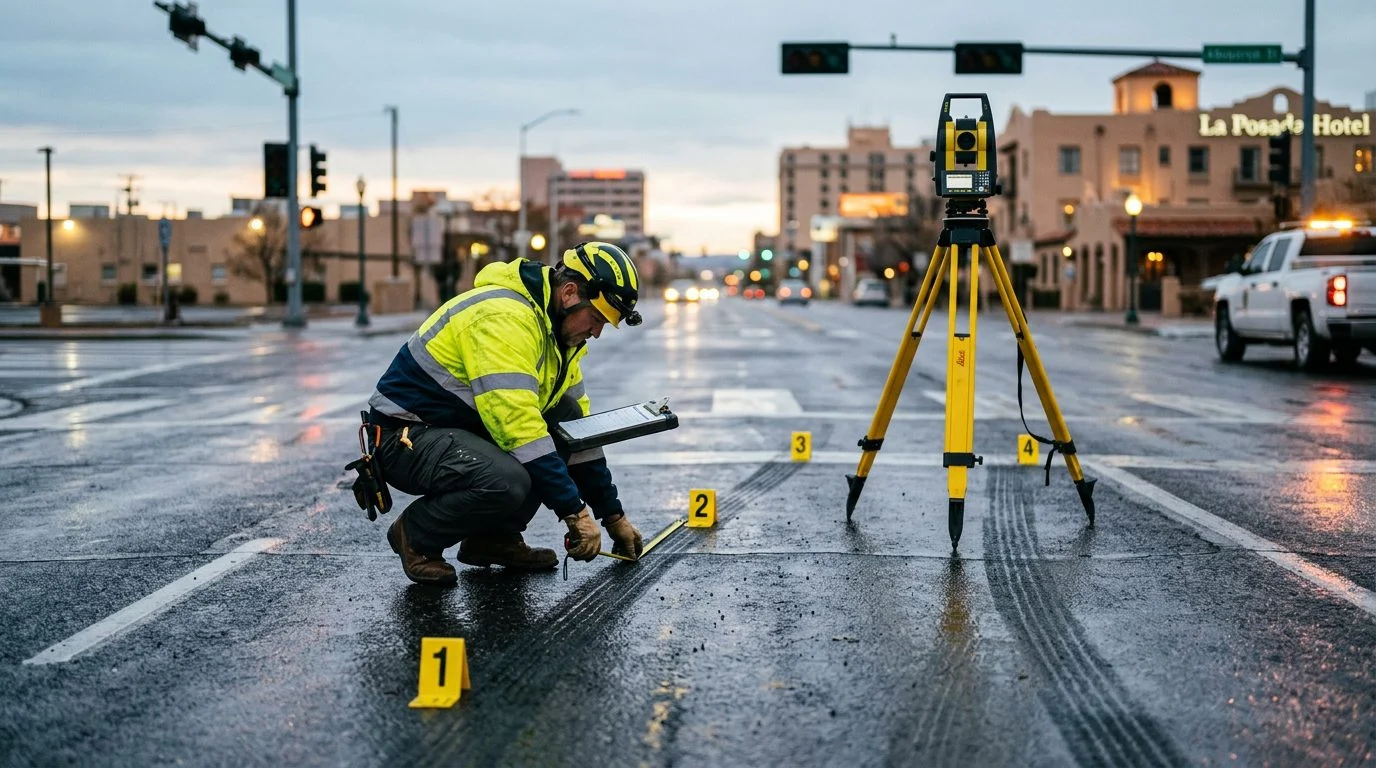
Evidence that tends to show breach includes crash reports, witness statements, dashcam and surveillance video, scene photos, traffic signal timing records, and vehicle inspection and maintenance records. In trucking cases, driver logs, electronic control module data, hours-of-service records, and maintenance files can matter. In premises and security cases, look at incident reports, prior complaints, lighting and maintenance records, and security staffing records.
A company that hands a vehicle to a driver can face a claim too. A negligent entrustment claim requires proof that the company entrusted the vehicle, knew or should have known the driver was incompetent, and that the incompetence caused the injury (DeMatteo v. Simon).
Proving Causation: Connecting the Conduct to the Death
Causation means the wrongful act was a significant link in the chain that led to the death. New Mexico’s jury instruction says the act must contribute to bringing about the injury and be reasonably connected to it as a significant link (UJI 13-305 NMRA).
Causation has two links. First, the act caused the injuries. Second, those injuries caused the death.
The act doesn’t have to be the only cause. It also doesn’t have to be the closest one in time. Herrera v. Quality Pontiac states that a proximate cause need not be the only, last, or nearest cause.
Evidence for the medical link includes the medical examiner or coroner report, autopsy findings, emergency and hospital records, notes from treating providers, and a clear timeline from the incident to the death. When death follows an injury by days, weeks, or months, the records from that gap often become central. Medical opinions explain how the injury led to the death. A lawyer should review those opinions against the full timeline.
Evidence to Gather and Preserve Early
Gather the records most likely to disappear first, and start early. Some evidence is overwritten or repaired quickly.
A crash report helps, but it isn’t a shortcut to proof. Other proof still has to carry the case.
Federal rules set retention periods for trucking records. A motor carrier, except a private motor carrier of passengers (nonbusiness), must retain maintenance records for 1 year and for 6 months after the vehicle leaves its control (49 C.F.R. § 396.3). Driver duty-status records must be kept for at least 6 months from receipt (49 C.F.R. § 395.8). Ask for these records early.
Vehicle event data recorders may preserve crash data that can serve as evidence after a fatal crash (NHTSA event data recorders).
Start a folder with these items: photos and video from the scene, witness names and phone numbers, the deceased’s messages that relate to the incident, vehicle or property damage records, medical and funeral records, and employment and income records. Keep originals when you have them. Log every insurer letter, bill, and notice by date.
A lawyer can send written requests asking other parties to keep evidence. Raise that step early, not late.
Proving Damages: What the Family Can Document
Damages are the losses the family can show, and the jury decides what is fair and just. Under NMSA § 41-2-3, the jury may award compensatory and exemplary damages it deems fair and just. The jury considers the pecuniary injury to the people entitled to the judgment and the circumstances of the wrongful act.
Families often document funeral and burial costs, medical bills from before the death, and the income and household support the person provided. Pay stubs, tax returns, employment records, records of household contributions, bills, and receipts help show those losses.
Loss of consortium is a separate claim. Thompson v. City of Albuquerque says those damages belong to the loss of consortium claimant, not to the decedent’s estate. The New Mexico committee commentary also treats wrongful-death damages and loss-of-consortium damages as separate (UJI 13-1830 NMRA).
What a claim is worth depends on the facts of each case.
Not sure what your next step is?
Talk it through with our team — the first consultation is free, confidential, and carries no obligation.
Timing, Key Takeaways, and Talking With a Lawyer
Under New Mexico’s wrongful death statute, every action must be brought within three years after the cause of action accrues, and the cause of action accrues as of the date of death (NMSA § 41-2-2). NMSA § 41-2-2 says the action must be brought within three years after the cause of action accrues, and that it accrues as of the date of death (NMSA 1978, § 41-2-2 — three years from the date of death).
Key takeaways:
- A claim needs proof of duty, breach, causation, and damages.
- Maintenance files, driver logs, and video can disappear, so preserve them early.
- A crash report generally can’t be used as trial evidence in New Mexico.
- Damages need documents.
Many families take this on while grieving. Holding dates, records, and questions at the same time can feel like a lot. You don’t have to sort them out in one sitting.
Common Questions
Wrongful death claims in New Mexico
Can a crash report prove fault?
Not by itself. Under New Mexico law, accident reports generally cannot be used as evidence at trial.
How long do trucking companies keep records?
Federal rules require maintenance records to be kept for 1 year. Driver duty-status records must be kept for at least 6 months.
Is loss of consortium a separate claim?
Yes. Under New Mexico case law, those damages belong to the close family member, not the estate.
If you’re piecing this together while grieving, you don’t have to do it alone. Our team can talk through what happened and which records matter most for your family. Your first consultation is free, confidential, and comes with no obligation to continue. Reach out through our contact page.
Responsible lawyer: Josh Wood, El Gringo Law, elgringolaw.com. Josh Wood is licensed in New Mexico and Arizona.
How We Approach a Wrongful Death Case
Reviewing the records
We look closely at police reports, medical records, employment and business documents, and other records that show what happened and why.
Preserving the evidence
Photos, vehicle data, surveillance footage and physical evidence can be lost over time. We work to identify and preserve what matters early.
Listening to the family
Families often know details no record will show. We take the time to understand the person who was lost and the impact on those left behind.
Planning the proof
We map out the evidence needed to show what happened, who is responsible, and the losses the family has suffered.
Don't Wait to Gather Information
Memories fade, records get purged, and physical evidence can be moved or repaired. If someone you love has died, talk with us sooner rather than later so that important proof is not lost while you focus on your family.
Types of Proof Often Involved
Cause of death
Autopsy reports, medical examiner findings and treatment records help connect the death to the event at issue.
Conduct of the responsible party
Witness statements, video, phone records, company policies and training files can show how the other party acted.
Losses to the family
Income records, household contributions, funeral costs and the loss of companionship and support all need careful documentation.
Context and timeline
Scene photos, maps, weather data and timelines help reconstruct exactly what happened before the death.