Spinal Cord Injuries · New Mexico
Partly to blame for the crash? Your spinal cord injury claim may still matter.
Shared responsibility raises hard questions, and insurers often press them early. Here is what to think about, and how to talk with our team in New Mexico.
By Josh Wood · Published November 10, 2026
If a crash left you with a spinal cord injury, and an adjuster says you share the blame, you may wonder whether you can still recover anything. A spinal cord injury lawsuit is not lost just because you were partly at fault. New Mexico applies comparative negligence, so being partly at fault may reduce your damages by your share of fault. Below, we explain how that reduction works and how the evidence fits in.
Can You Recover If You Were Partly at Fault in New Mexico?
Yes. New Mexico uses pure comparative negligence, so partial fault reduces a recovery instead of blocking it. The New Mexico Supreme Court adopted this rule in Scott v. Rizzo. Comparative negligence was adopted in New Mexico in Scott v. Rizzo.
The word “pure” matters. A claim does not end just because you share some of the blame. Instead, your share of fault is compared with the other side’s share, and that split changes how much you can recover.
Many people assume any fault ends a claim. That assumption is wrong under New Mexico’s rule, but the amount you recover can still drop.
Whether you were partly at fault is decided on the facts of your own crash. Your question is about one collision, so the evidence from that collision carries the weight, not a general rule.
How Is a Fault Percentage Applied to Damages?
A fault percentage is subtracted from your total damages, and what remains is your recoverable amount. New Mexico’s pattern jury instruction, UJI 13-2218 NMRA, sets out how damages are calculated when the plaintiff’s injury was caused by a combination of the defendant’s negligence and the plaintiff’s negligence. It is used only when comparative negligence is an issue in the lawsuit, the court submits the case on a general verdict without special interrogatories, and there is no apportionment of negligence among defendants or non-parties.
- Find the total amount of damages.
- Assign percentages to the plaintiff and the defendant so they total 100 percent.
- Reduce the plaintiff’s total damages by the plaintiff’s percentage.
The steps run in order. Total damages come first, then the fault split, then the reduction.
Here is a simplified illustration, not a prediction of any case. Suppose total damages were $500,000 and the jury assigned you 20 percent of the fault. The reduction is $100,000, leaving $400,000. A different fault split or a different total would change the dollar result.
When more than one defendant is at fault, NMSA 1978, § 41-3A-1 generally makes each defendant liable only for its own share. The statute also lists exceptions, including cases involving intentional harm, so a multi-defendant case needs a closer look.
Why Do Insurers Raise Partial Fault Arguments?
Insurers may raise partial fault early because a fault argument can justify a lower offer. An adjuster may look for anything that suggests you contributed to the crash. Common examples include speed, lane position, distraction, and following distance.
Following distance is one example. New Mexico law says a driver must not follow another vehicle more closely than is reasonable and prudent (§ 66-7-318).
An argument made early can shape an offer before the full extent of the injury is known. A fault argument is still one side’s position. It gets tested against physical evidence, witness accounts, and medical records. It is not accepted just because an adjuster raises it.
Early statements can be used later. Take care with what you say, to whom, and when, especially in the first days after a crash.
How Do Medical Records and Imaging Address Fault Questions?
Medical records answer a different question than fault. They show how badly you were hurt and whether the crash caused that injury. New Mexico’s causation instruction asks whether an act was “reasonably connected as a significant link to the injury” (UJI 13-305 NMRA).
Emergency room notes, MRI and CT scans, and neurology evaluations record where the spinal cord was injured and when symptoms began. Records made close to the crash help tie the injury to the collision. Medical timelines and imaging do not decide who caused the crash. They help answer how severe the injury is.
Negligence has its own test.
Gaps in treatment can give an insurer a reason to question how serious the injury was. Keeping appointments and following medical advice helps build a complete record.
How Do Crash Evidence and Witness Accounts Factor In?
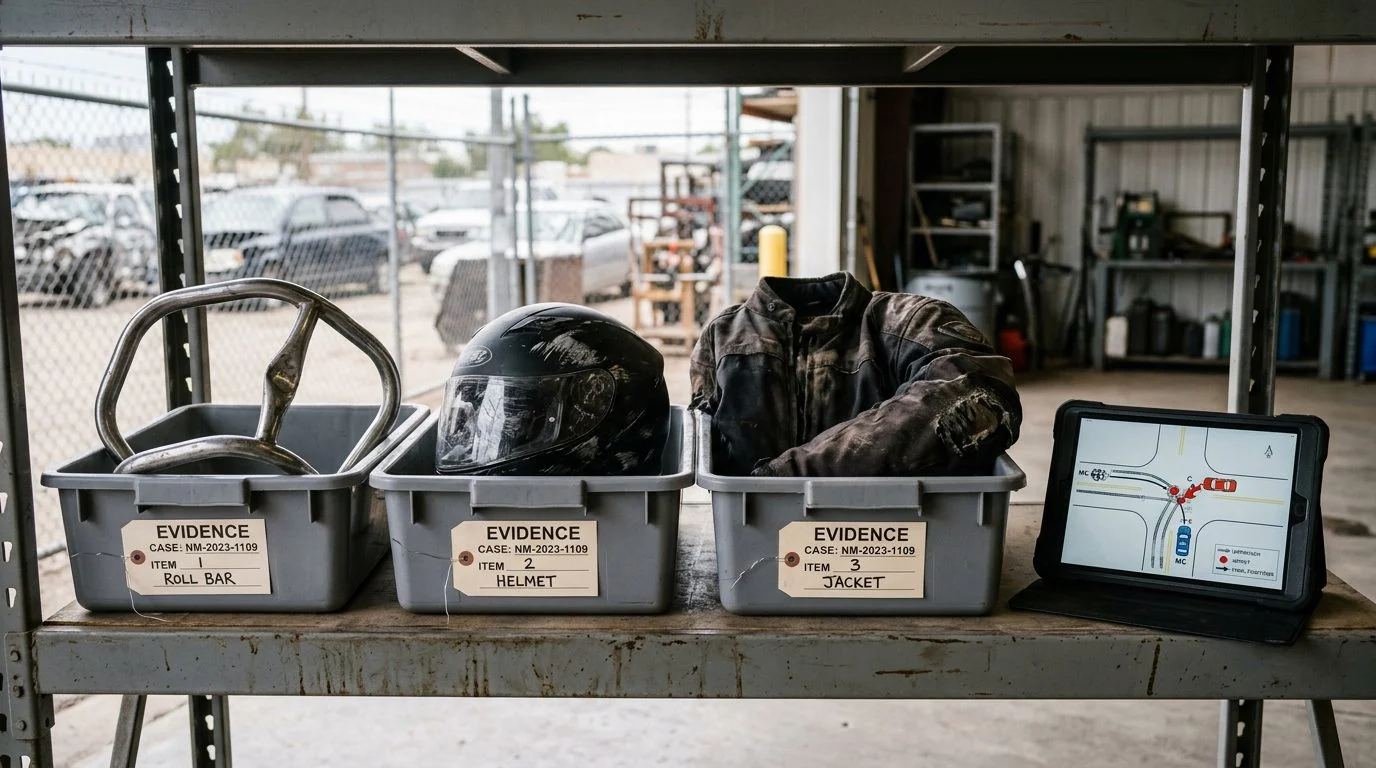
Crash evidence and witness accounts show how the collision happened. That sequence sits at the center of any fault argument. Evidence that often matters includes photos of vehicle damage and the scene, road and traffic conditions, nearby business video, and vehicle data where available. Police reports are part of the picture too.
New Mexico keeps accident reports made by people involved in a crash confidential for use by state agencies, though the state highway and transportation department may disclose certain facts, such as a person’s identity when it is not otherwise known or whether the vehicle’s owner or operator is insured. The statute also generally bars using those reports as evidence at trial, so other evidence often carries more weight (§ 66-7-213).
Witnesses matter when drivers’ accounts differ. Independent witnesses can help clarify the order of events.
Write down your memory of the crash as soon as you’re able, while details are fresh. Include small details too, like the weather, the lights, and where each vehicle stopped. Keep photos from the scene and the days after.
The same evidence can help or hurt a fault argument, so it’s reviewed as a whole, not from one document.
Talk With Our Team About Your Situation in New Mexico
A spinal cord injury can leave you with hard questions about blame, bills, and what comes next. Discussing your situation in a free, confidential initial consultation, with no obligation to continue, is a reasonable first step.
Josh Wood is the responsible lawyer for this page. Josh Wood is licensed in New Mexico. Our lawyers handle car accidents, trucking accidents, premises liability, and catastrophic injuries, including spinal cord injury cases. This page is for people in New Mexico communities such as Santa Fe and Rio Rancho.
Your first consultation is free, confidential, and without obligation to continue. To describe your crash and your injury, use our contact form.
Frequently Asked Questions
Can I recover damages for a partly at fault spinal cord injury lawsuit in New Mexico?
Yes. Under New Mexico’s pure comparative negligence rule, your damages are reduced by your share of fault rather than barred.
Does the insurance adjuster decide my share of fault?
No. An adjuster states a position, but fault is tested against the evidence, and at trial the jury compares each person’s negligence.
Do gaps in treatment affect a spinal cord injury claim?
They can. An insurer may use gaps in care to question how serious the injury was.
Why people bring their case to El Gringo Law
We focus on serious injuries
Our firm concentrates on car accidents, trucking crashes and catastrophic injuries, including spinal cord injuries, across New Mexico.
A free, confidential first consultation
Talk with us about what happened and what you are facing. The first consultation is free, confidential and comes with no obligation to continue.
Our team answers your questions
Our lawyers and support staff explain each step in plain language, so you know what to expect.
Serving communities across New Mexico
We work with people in Santa Fe, Albuquerque's surrounding areas, Las Cruces, Farmington, Taos and beyond.
Be careful with the insurance adjuster
An adjuster may call soon after a crash, ask for a recorded statement, or suggest you share the blame. Speaking with a lawyer before you give a statement or sign anything can help you understand your position.
How we can help you get started
Gather your records
Medical reports, crash reports, photos and the names of witnesses help build a clear picture of what happened.
Understand the other side's argument
We look closely at what the insurer or the other driver claims, so you can respond with facts rather than guesses.
Plan your medical care
Your health comes first. Keep your appointments and tell your doctors everything about your symptoms and limitations.
Talk with our team
Call or send a contact form to start a free, confidential consultation with no obligation to continue.