Wrongful Death · Trucking Accidents · New Mexico
Holding a Trucking Company Accountable After a Wrongful Death
A clear, step-by-step guide for families facing the loss of a loved one in a truck crash, from the first call onward.
By Josh Wood · Published November 9, 2026
Losing someone in a crash with a semi-truck raises hard questions fast. Can the family sue, and who can they name? Yes. New Mexico’s wrongful death law lets a family bring a claim against the people whose negligence caused the death, which can include the truck driver and the trucking company.
This page answers three questions: who can file, who may be responsible, and how much time a family has. Every crash is different, so the details of yours matter.
Yes, a Family Can Sue, but the Right Defendants Depend on What Happened
Yes. Under New Mexico’s wrongful death statute, when one person’s wrongful act, neglect or default causes a death, the person who would have been liable had death not followed can be sued for damages. The rule applies even though the injured person has died.
In a truck crash, that can mean more than one defendant. The driver may be liable. So may the company that employed the driver, and sometimes other businesses tied to the load or the truck. Which parties can be named depends on the facts of the crash, so the family should look at the whole picture.
A wrongful death case is a civil case. It asks a court for money damages from the parties at fault. The civil claim asks a separate question from the criminal case: who was at fault, and what did the death cost the family?
If your family is deciding whether to sue after a fatal truck crash, our team can talk through who may be responsible. The first consultation is free, confidential and comes with no obligation to continue. Talk it through with our team — the first consultation is free, confidential, and carries no obligation.
Who Can Bring a Wrongful Death Claim in New Mexico
The claim is brought by the personal representative of the deceased person’s estate. Under NMSA 1978 § 41-2-3, every action mentioned in Section 41-2-1 NMSA 1978 shall be brought by and in the name of the personal representative of the deceased person.
Without a spouse, children and grandchildren take the proceeds. Later steps name parents and then siblings in certain cases.
Before filing, the family should confirm who can act as personal representative. Our team can walk through that step during a consultation.
Can You Sue the Semi-Truck Driver?
Yes. A driver whose negligence caused a fatal crash can be named as a defendant.
New Mexico negligence claims generally need a duty owed to the plaintiff, a breach of that duty, and a breach that was a proximate cause of the damages. The breach is usually measured by reasonable care. See Herrera v. Quality Pontiac.
Driver conduct is often the focus. Fatigue is one example. Federal rules say no driver may operate a commercial vehicle when fatigue, illness or another cause makes it unsafe, except that in a case of grave emergency where the hazard to occupants of the commercial motor vehicle or other users of the highway would be increased by compliance with this section, the driver may continue to operate the commercial motor vehicle to the nearest place at which that hazard is removed, under 49 C.F.R. § 392.3. Hours limits also apply. Under 49 C.F.R. § 395.3, a driver of a property-carrying commercial motor vehicle may not drive after a period of 14 consecutive hours after coming on duty following 10 consecutive hours off duty, except as otherwise provided in § 395.1.
Fault can be split among defendants. Under NMSA § 41-3A-1, in causes of action to which several liability applies, a defendant who establishes that another’s fault is a proximate cause of the plaintiff’s injury is liable only for the portion of the damages equal to the ratio of that defendant’s fault to the total fault attributed to all persons, including plaintiffs, defendants and persons not party to the action. The statute also lists exceptions, such as where one party is vicariously liable for another. That is one reason the driver and the company are often both named.
When Is the Trucking Company Responsible?
A trucking company can be responsible for a driver’s negligence when the driver was acting within the scope of the job. It can also answer for its own decisions.
For a claim that the company is liable for the driver’s conduct under respondeat superior, the plaintiff must show the driver was acting within the scope of employment, according to the UJI 13-1647 NMRA commentary. The company’s own decisions form a separate claim. The UJI instruction asks whether the company knew or should have known the driver would create an unreasonable risk of injury to a group or class that includes the plaintiff. It also asks whether the company failed to use ordinary care in hiring, retaining or supervising that driver. That claim does not require the driver to be on the job when the crash happened.
Whether a company properly vetted the driver it placed behind the wheel can be an important question in a trucking case.
Compliance records often carry weight in these cases. Each motor carrier must keep a driver qualification file for each driver. It must keep that file while the driver works and for three years after, except that certain records listed in paragraph (d) may be removed three years after their date of execution, under 49 C.F.R. § 391.51.
Under federal trucking rules (49 C.F.R. § 382.303), an employer must test surviving drivers for alcohol only in certain crashes: where the accident involved a human fatality and the driver was performing safety-sensitive functions with respect to the vehicle, or where the driver receives a citation within 8 hours of the occurrence for a moving traffic violation arising from the accident and the accident involved bodily injury requiring immediate medical treatment away from the scene or disabling damage requiring a motor vehicle to be transported away by a tow truck or other motor vehicle. Under 49 C.F.R. § 382.303, one situation in which the employer must test a surviving commercial driver for alcohol is when the driver receives a citation within 8 hours of the occurrence under State or local law for a moving traffic violation arising from the accident, and someone hurt in that accident, because of the injury, is immediately treated somewhere other than the crash site. Under federal rules, when a required post-accident alcohol test is not given within two hours, the employer has to keep a written record explaining why. After eight hours, it must stop trying to give the alcohol test. For a controlled substances test, the employer must stop trying after 32 hours and keep a record of the reasons the test was not promptly given (49 C.F.R. § 382.303).
Other Parties Who May Be Responsible for a Fatal Truck Crash
Other businesses can be responsible when their own conduct helped cause the crash. Common examples include:
- Cargo shippers or loaders, whose improper loading or securement can contribute to a rollover or cargo spill.
- Freight brokers, who arrange the load.
- Maintenance and repair shops, if faulty brake, steering or tire work contributed to the crash.
- Manufacturers, if a defect in design or manufacture contributed.
Each one is named only when the facts support it. Being on this list does not mean a business was at fault.
What a Family Generally Has to Show
A family generally has to show that the defendant owed a duty, breached it, and that the breach caused the family’s damages.
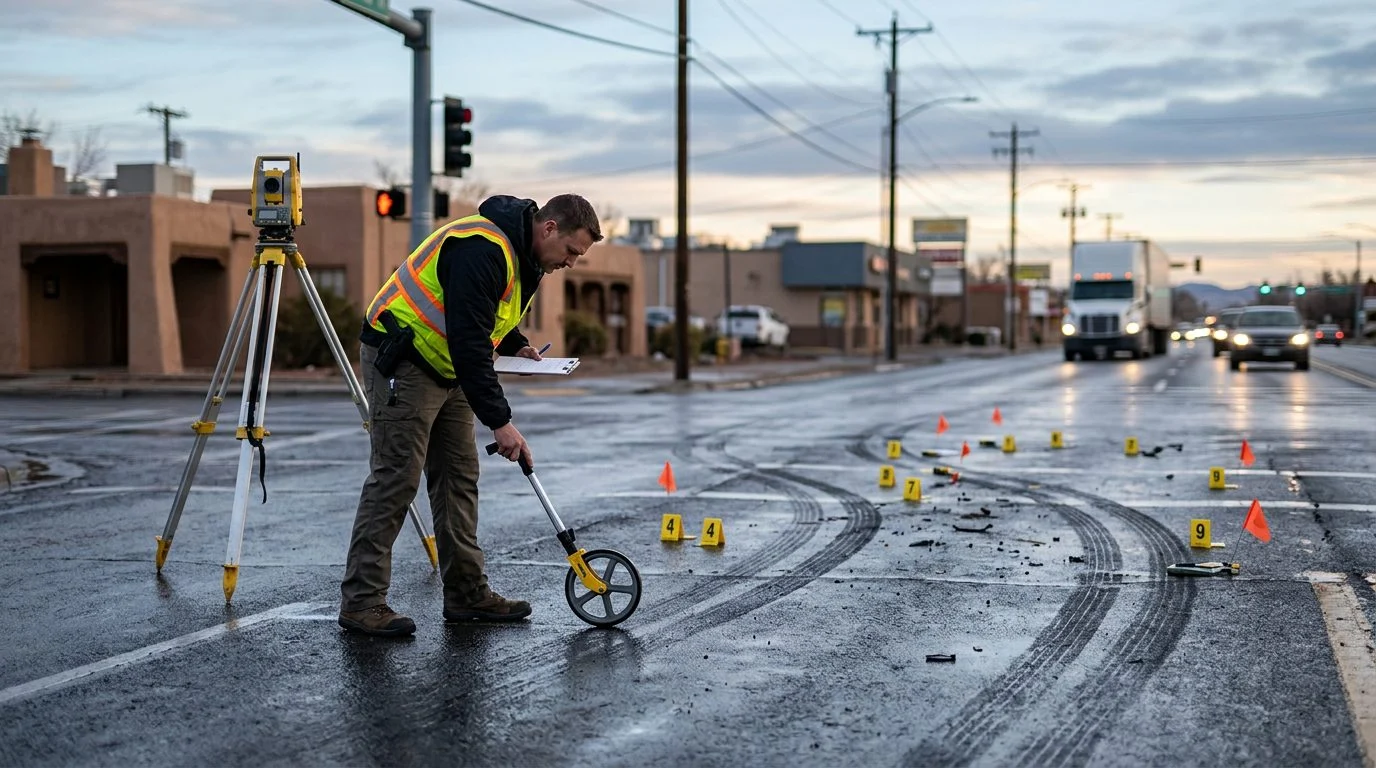
Proof usually comes from records. Crash reports, driver logs, qualification files, inspection and maintenance records, and testing records can all matter. Witness statements add to that record, and a review of the crash can help explain it.
Not sure what your next step is?
Talk it through with our team — the first consultation is free, confidential, and carries no obligation.
Which Court Hears the Case and How Much Time Does a Family Have
New Mexico gives a family three years to bring a wrongful death action (NMSA 1978, § 41-2-2 — three years from the date of death). Under NMSA 1978 § 41-2-2, every action instituted under Section 41-2-1 NMSA 1978 must be brought within three years after the cause of action accrues, and the cause of action accrues as of the date of death. Under New Mexico law, § 41-2-2 provides that the cause of action accrues as of the date of death.
Waiting costs time. Records can be lost and memories fade, so starting early helps.
Other rules can change the timing. If a government vehicle or employee was involved, different notice and filing rules can apply. That question should be raised early.
Which court hears the case is part of early review. The choice is based on the parties and what the crash involved.
Steps a Family Typically Takes After a Fatal Truck Crash, and How to Reach Us
The first steps focus on evidence and records. Families often do these things in the first days and weeks:
- Save photos and write down the names of witnesses from the scene.
- Get the police report.
- Keep bills for medical care and funeral costs.
- Write down what witnesses said while memory is fresh.
Settling and filing a lawsuit follow different timelines and carry different tradeoffs. Each path should be reviewed before a family commits to either.
Frequently Asked Questions
Can a family sue a truck driver for wrongful death in New Mexico?
Yes. A driver whose negligence caused the death can be named as a defendant.
How long does a family have to file?
Under New Mexico’s statute, the action must be brought within three years after the cause of action accrues, which is the date of death (NMSA 1978, § 41-2-2 — three years from the date of death).
If your family is weighing whether to sue a trucking company and its driver after a fatal crash, our team can help you talk through who may be responsible. The free, confidential initial consultation comes with no obligation to continue. You can reach us through our contact form.
This page is the responsibility of Josh Wood, a lawyer licensed in New Mexico and Arizona with El Gringo Law. You can reach the firm at elgringolaw.com or through the contact form above.
How El Gringo Law works with families
A confidential first conversation
Your first consultation is free, confidential, and comes with no obligation to continue. We listen first, then explain what we can and cannot do.
Early attention to evidence
Trucking companies often begin protecting their side soon after a crash. We focus on identifying and preserving the records that matter to your family's case.
Plain-language updates
Our team keeps families informed in plain language about where their case stands and what decisions lie ahead.
Respect for your loss
We understand that a wrongful death case is about a person, not just paperwork. We approach each family with patience and care.
Don't wait to ask questions
Trucking companies and their insurers may move quickly after a fatal crash. Speaking with a lawyer early can help your family understand its options and protect important evidence.
What families often want to understand
Who may be responsible
A claim can involve the driver, the trucking company, or others connected to the crash, depending on the facts of each case.
Evidence that can shape a case
Driver logs, maintenance and inspection records, dashcam footage, and the crash report are among the materials that can matter.
What the first call involves
A free, confidential consultation gives you a chance to share your situation and ask questions, with no obligation to continue.