New Mexico Spinal Cord Injury Claim Before MMI
By Josh Wood · Published November 14, 2026
If you or a family member has a spinal cord injury from a crash or fall, treatment, bills, and hard questions can all arrive at once. One question comes up often: can a spinal cord injury claim move forward before maximum medical improvement (MMI)? In general, yes. The claim can be opened, investigated, and documented before MMI. What usually waits is the valuation, the estimate of lasting harm, because lasting effects aren’t clear until the medical picture settles.
This page gives general information about New Mexico law. The facts of each crash and injury shape the answer. For the wider picture, read our New Mexico spinal cord injury claim guide.
Why Timing Matters When a Spinal Cord Injury Changes Your Life
Timing has two separate parts. The first is whether a claim exists and can be started. The second is when its value can be estimated. People often mix these up, and that can lead them to wait on everything until treatment ends.
A claim generally rests on someone else’s negligence. In a car crash, that might be a driver who ran a red light. In a fall, it might be a property owner who missed a hazard. Those facts are easiest to pin down early, while memories are fresh and records still exist.
Valuation is different. It asks what the injury will cost over time and how it changes daily life. Those answers need a stable medical record. So the valuation tracks MMI, while the work of building the claim starts much sooner.
What Maximum Medical Improvement Means
MMI is the point where a person’s condition has stabilized. A treating physician judges that more treatment is not expected to change it much. MMI is a medical judgment. It is not a legal deadline.
Patients often hear MMI described as the end of recovery. It is better understood as the point where the picture is steady enough to measure. Life with the injury continues after that point.
Stabilization looks different for each person. Doctors describe complete and incomplete spinal cord injuries differently. MedlinePlus explains that both kinds can cause paralysis. Injuries at different levels of the spine also follow different recovery patterns. Some people keep improving for a long time. Others level off sooner.
That’s why no single date fits everyone. The treating team watches progress over time and decides when the picture is steady enough to rate.
Being near MMI doesn’t end treatment. A person can still be in rehab, follow-up visits, or equipment fittings when a claim is opened. Those visits build the record that matters later.
Why a Claim Is Usually Valued Once the Medical Picture Is Stable
A claim is usually valued after the medical picture is stable because value depends on lasting effects. Those effects are hard to estimate while the condition is still changing.
A valuation tries to answer two core questions. First, what will the injury likely cost in care and lost income over time? Second, how does it change daily life, work, family roles, and independence?
Valuing too early can miss needs that appear later. A person may still be learning how much help they’ll need at home. A new device or surgery may come months into recovery. An estimate that ignores these facts can understate the claim.
The medical record also needs to tie each limit to the crash or fall. Notes that connect the symptoms to the incident make the valuation easier to follow.
Waiting has a cost too. Evidence fades, and records get harder to pull. The practical approach is to build the file now and finish the valuation when the medical picture is steady.
What Can Happen Before MMI: Building the Claim
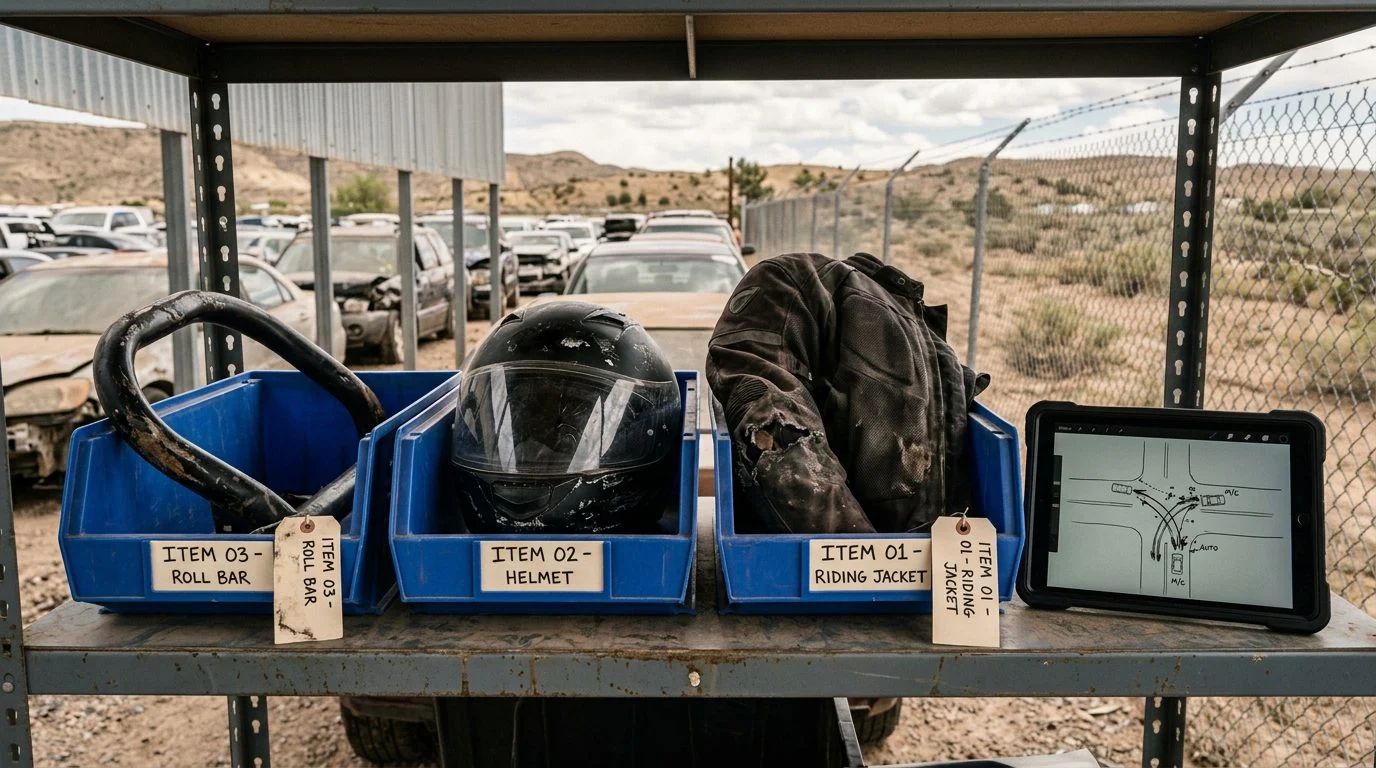
Early steps focus on facts that can disappear. Preserve the crash or incident details, collect reports, and identify every party and insurer involved.
New Mexico sets crash reporting rules. The driver of a vehicle involved in a crash with bodily injury, death, or total property damage of $500 or more also must send a written report to the department of transportation within five days (NMSA 1978, § 66-7-207). Officers have their own deadline, 24 hours after they finish an investigation, in the same section.
Car and trucking crashes produce early evidence such as vehicle damage, photos, and witness contact information. Trucking cases add a time limit. Federal rules require motor carriers to keep drivers’ records of duty status and supporting documents for at least six months from receipt (49 C.F.R. § 395.8). Six months is short, so early requests matter. Premises cases turn on maintenance and inspection records, and on photos of the spot where the injury happened.
Keep your appointments and follow the treating team’s plan. That treatment record is what a later valuation relies on.
Early insurer talks deserve planning. Rule 11-409 NMRA keeps evidence of offers to pay medical expenses out of evidence when someone tries to prove liability for the injury. Even so, it helps to think through what you’ll say before a recorded call.
How Doctors Document Permanent Impairment and When It Is Rated
After stabilization, treating physicians may document permanent impairment. That means lasting loss of function that remains after treatment ends.
Documentation often covers motor and sensory function, mobility, bladder and bowel function, and any need for assistive devices. A rating is usually requested once MMI is reached. Because the rating describes what lasts, it often becomes central to how the claim’s value is discussed.
Imaging, functional testing, and therapy notes all add to the record. Imaging shows the structure of the injury. Therapy notes show how the person moves and handles daily tasks over time. Gaps in care can make the record harder to read, so consistent follow-up matters.
For how impairment fits into a New Mexico claim, see our permanent impairment claim page.
Current and Future Medical Expenses
A spinal cord injury claim can include medical bills already incurred and the expected cost of future care. That future piece is why the record before MMI matters.
Future care often includes surgery, rehabilitation, medications, equipment, attendant care, and follow-up monitoring. Treating providers are the ones who can say what care is likely. Home and vehicle modifications and wheelchair costs can also be part of future needs. Our home modifications and wheelchair costs page covers those in more detail.
Future needs can change as the person’s condition changes. That’s why the estimate often needs updating as the record grows.
Keep bills, receipts, and visit notes in one place. Write down the date of each visit and the provider’s name. A simple log makes the care history easier to explain later.
Lost Income and Earning Capacity
Lost income covers pay already missed. Earning capacity covers the reduced ability to earn over the years ahead. Both can matter, and they are different.
Job type, education, the physical demands of the work, and age at injury all affect how lost earning capacity is judged. Two people with the same injury can face very different limits. A person who does manual labor may face different restrictions than someone who works at a desk. A permanent restriction written by a physician can be central to this discussion.
Keep pay stubs, tax returns, and job descriptions. Note missed work, reduced hours, and job changes after the injury. Those records show what changed and when.
Each person’s work history is its own. That’s why this category is assessed case by case.
Economic vs. Non-Economic Damages
Economic damages are measurable money losses. Non-economic damages are harms that don’t come with a receipt.
Economic damages include medical bills, future care costs, and lost wages. Non-economic damages can include pain, loss of enjoyment of life, emotional distress, and changes in relationships and personal identity. Emotional and personality changes can follow a serious spinal injury. They are part of how the claim is described to insurers.
Family members can have their own claims. Loss of consortium damages result from a wrongful injury to someone in a close relationship with the claimant. Those damages belong to that claimant, not the injured person (Thompson v. City of Albuquerque).
Coverage limits also matter. The at-fault driver’s or property owner’s insurance limits can affect how much is available to recover. See our policy limits page.
How the Cause of the Injury Affects Timing and Value
Car crashes, trucking accidents, and premises cases each involve different parties, insurers, and proof. That mix changes the work needed before a valuation.
New Mexico uses comparative negligence. A person’s own share of fault reduces what they recover, but it does not automatically bar recovery. The jury reduces total damages by the plaintiff’s percentage of negligence (UJI 13-2218 NMRA). New Mexico adopted this rule in Scott v. Rizzo. Where more than one defendant is at fault, NMSA 1978, § 41-3A-1 generally limits each defendant to its own share, with exceptions the statute lists.
A negligence claim generally requires a duty, a breach of that duty, and a breach that is a proximate cause of the harm (Herrera v. Quality Pontiac). A proximate cause need not be the only cause, or the last or nearest one.
Premises cases follow a duty of ordinary care. An owner or occupant owes a visitor the duty to keep the premises safe, whether or not a dangerous condition is obvious. Where there is evidence that the owner or occupant failed to make a reasonable inspection that would have revealed the condition, or that the condition was caused by the owner or occupant or their employees, the owner or occupant is charged with knowledge of that condition (UJI 13-1318 NMRA). That makes inspection records part of early work.
Trucking cases can move on a set timeline. Under 49 C.F.R. § 382.303, whether an employer must test a surviving commercial driver for alcohol and controlled substances after a crash depends on specific conditions. In non-fatal crashes, testing is generally required when the driver receives a citation for a moving violation arising from the crash within 8 hours (for alcohol) or within thirty-two hours (for controlled substances), and the crash involved injury requiring immediate medical treatment away from the scene or disabling vehicle damage requiring a tow. Fatal crashes are treated separately, and testing must be completed within set time limits. If an alcohol test isn’t given within two hours, the employer must keep a record of why (49 C.F.R. § 382.303).
Establishing fault is part of building the claim before the valuation is final.
Deadlines and Why Timing Matters in New Mexico
New Mexico law generally allows three years to file a lawsuit for an injury to a person (NMSA 1978, § 37-1-8). Other deadlines can apply to specific claims or parties.
The filing deadline is set by law, not by the MMI date. A claim can be opened well before MMI. Acting early also helps preserve evidence. Records can be purged, witnesses can move, and vehicles get repaired.
Early steps protect evidence. The value of a claim still comes from the full medical and financial record. That record keeps growing while treatment continues.
Frequently Asked Questions
Can a spinal cord injury claim be opened before MMI?
Yes. A claim can be opened, investigated, and documented while treatment continues.
Does the number of therapy sessions set a claim’s value?
No single treatment step sets the value. Therapy records show progress and limits, and a valuation considers them with the rest of the medical record.
Does an MRI decide what a spinal cord injury claim is worth?
Imaging is one part of the record. Value depends on the full picture of the injury, treatment, and lasting effects.
Does MMI set the filing deadline?
No. The filing deadline is set by law, not by MMI. New Mexico generally allows three years for an injury to a person.
Can a settlement be paid over time?
Yes, some settlements are structured to pay over time. See our structured settlement page.

Talk With El Gringo Law About Your Spinal Cord Injury Claim
If you’re caring for someone still in treatment, or you’re living with the injury yourself, this can feel like too much at once. Records are building, and the question of when a claim can be valued is hard to answer alone.
If that sounds familiar, you can reach out to El Gringo Law. We can talk through the crash, the injury, and your timing questions in plain terms. Our initial consultation is free, confidential, and carries no obligation to continue.
Josh Wood is the responsible lawyer for this page. He is licensed in New Mexico and Arizona. You can reach El Gringo Law through its contact form or at elgringolaw.com.