Wrongful Death | Albuquerque, New Mexico
After a Fatal Crash, Your Family's Evidence Matters
Learn which photos, records and documents can support a wrongful death claim, and how to protect them while your family is grieving.
By Josh Wood · Published November 9, 2026
A family pursuing a fatal crash claim in Albuquerque needs the crash report, scene and vehicle evidence, witness details, electronic data, and medical and funeral records. Start with the items that disappear fastest: the vehicle, camera footage, and phone data.
New Mexico law makes a person who causes a death through a wrongful act or neglect liable in damages, even though the injured person has died. Section 41-2-1 sets out that rule. The sections below walk through the proof to gather, in the order it matters most.
Police and Crash Reports
The crash report is usually the first official record of the scene, the parties, and the vehicles involved.
Questions about reporting a crash to police or the sheriff, and about any written report, can be discussed with our team during your free, confidential initial consultation, which carries no obligation. Reports to the Department of Transportation may be required after a crash involving a commercial truck, and our team can review which reports apply to your case.
Write down the responding agency, the report number, the date, and the officer’s name. Ask whether a supplemental report or a citation exists. Keep every card or notice handed to you at or after the scene.
The report is not the whole case. Under § 66-7-213, accident reports are for confidential state use, and they generally cannot be used as evidence in a civil or criminal trial arising from the crash, subject to the exceptions the statute lists. That makes your other evidence matter more.
If your loved one died in a crash in Albuquerque, Rio Rancho, or Sandoval or Bernalillo County, we can help you sort out which records to request first. Talk it through with our team — the first consultation is free, confidential, and carries no obligation.
Photographs, Video, and the Scene
Photos and video show where the vehicles came to rest, how they were damaged, and what the road looked like at the time.
The most useful images include vehicle positions, damage on every side, road markings and signals, skid marks, debris, fluid trails, and weather or lighting conditions. Ask passengers who survived, bystanders, and nearby drivers to share what they took. Photos from a phone can be as useful as official images.
Ask each person to send the original files, not only social media copies. Original files keep the date, time, and location data. Keep them in one folder, with a note about who took each photo.
Business and traffic cameras matter too. Many camera systems record over old footage on a set schedule, so ask early. Red-light camera images can also provide crash-related evidence, and trained staff typically review them to verify the vehicle and the violation (Insurance Institute for Highway Safety).
Witness Names and Contact Information
A witness’s full name and phone number are worth more than a general description of who was there.
Write down every name you hear, with a phone number or email and what that person said they saw. Include passengers, nearby drivers, people who called 911, and any first responder whose name appears on paperwork.
Memories fade and people move. Early contact information helps keep a witness’s account intact. Keep one notebook or digital file with names, dates, and each person’s account, so nothing gets lost between family members.
Vehicle Damage and Repair Records
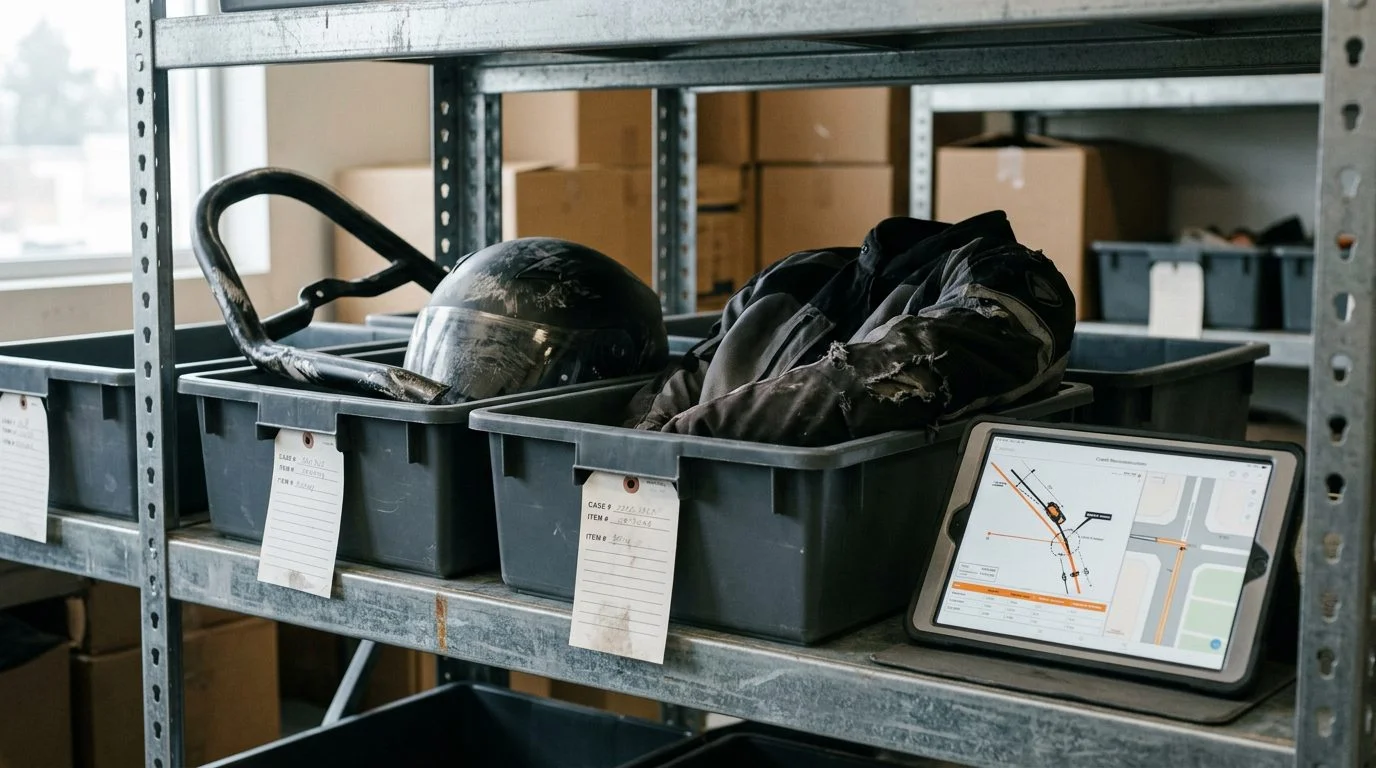
The vehicle can show speed, impact angle, and how the crash unfolded, so keep it unrepaired until someone has documented it.
Ask the tow yard and the insurance company to hold the vehicle in writing. Ask them to tell the family before any inspection, sale, or scrapping happens. Keep tow and storage receipts, the vehicle’s current location, claim file numbers, appraisal reports, and repair estimates.
Many vehicles have an event data recorder. The National Highway Traffic Safety Administration explains that these systems may preserve pre-crash, crash, driver-input, restraint, and post-crash information that can serve as evidence after a crash (NHTSA). Repairing or selling the vehicle can cause that data to be lost.
If a commercial truck was involved, federal rules add a separate layer. The Federal Motor Carrier Safety Administration states 8-hour and 32-hour deadlines for post-accident alcohol and drug testing after a fatal crash (FMCSA). Contact our team right away about any truck involved.
Phone, Dashcam, and Electronic Data
Phone records, dashcam files, and app logs can show what each driver was doing in the minutes and hours before a crash.
Dashcam footage often sits on a memory card or a cloud account. Those files can be overwritten or deleted by routine settings, so ask who controls the device and the account.
Do not delete, reset, or wipe the decedent’s phone or accounts, even if closing them feels necessary. Keep the device powered off and stored safely. Carriers keep call and text details for limited periods, so contact our team early about what to request and when.
Navigation history and rideshare or delivery app logs can show a timeline of trips before the crash. A timeline is often the clearest way to show where a person was and when. Keep screenshots only as a backup, not as a replacement for the original data.
Medical, EMS, and Medical Examiner Records
EMS run reports, hospital records, and medical examiner findings document the injuries and the cause of death.
Ask for copies of any records already in your hands. Families often receive paperwork at the hospital or the coroner’s office. Keep a list of every provider and facility that treated the person before death, with dates.
You may need to sign release authorizations so records can move to the family’s lawyer. Ask each provider how long it takes to produce records, and keep a log of each request.
Toxicology results, when they exist, appear in these records. Review them with a lawyer rather than reading them alone, because a single number can be misunderstood without context.
Not sure what your next step is?
Talk it through with our team — the first consultation is free, confidential, and carries no obligation.
Funeral and Expense Receipts
Receipts for funeral, medical, and other out-of-pocket costs prove the financial side of the loss.
A wrongful death action is brought by the personal representative of the deceased person. The jury may award compensatory and exemplary damages it deems fair and just, taking into account the pecuniary injury to the surviving party entitled to the judgment and the mitigating or aggravating circumstances of the wrongful act, neglect or default (NMSA § 41-2-3). Receipts help show that injury in concrete terms.
Keep invoices, payment confirmations, cancelled checks, and card statements. Keep mileage logs for funeral-related trips. Keep EMS and provider bills, with the billing statement from each provider.
Lost income and household support are proven with pay stubs, tax returns, employer letters, and records of the decedent’s usual role at home. Loss of consortium damages belong to the close family member who claims them, not to the decedent’s estate (Thompson v. City of Albuquerque).
Why Evidence Disappears and How Preservation Letters Work
A preservation letter is a written demand that the people holding evidence keep it intact.
Vehicles get repaired or sold. Camera footage gets overwritten. Phone data gets purged, and witnesses move. Evidence can be lost within days or weeks, which is why waiting for a claim to be filed is a risk.
A lawyer can prepare and send preservation letters to the other driver, insurers, tow yards, businesses, and others holding evidence. That puts them on notice early and asks them to keep what they have.
Timing matters under the statute too. A wrongful death action must be brought within three years after the cause of action accrues, and it accrues as of the date of death (NMSA § 41-2-2). If a government vehicle or employee is involved, the Tort Claims Act’s notice rules can apply, so raise that question early (Lopez v. State).
Next Step: Talk With El Gringo Law About Your Family’s Crash
If your loved one died in a crash in Albuquerque, Rio Rancho, or Bernalillo or Sandoval County, you do not need every record before you call.
The first questions are which reports to request, which vehicle and phone to hold, and who to ask to preserve evidence. El Gringo Law can talk through what your family has gathered so far and what still needs to be requested. Your first consultation is free, confidential, and comes with no obligation to continue.
To reach us, use the El Gringo Law contact page. This page is the responsibility of Josh Wood, who is licensed in New Mexico and Arizona, and the El Gringo Law team.
Frequently asked questions
How long does a family have to file a wrongful death claim in New Mexico?
The action must be brought within three years after the cause of action accrues, and it accrues on the date of death (§ 41-2-2).
Can the police crash report be used as evidence?
Generally, no. The statute says accident reports are not used as evidence in a trial arising from the crash, subject to the exceptions it lists (§ 66-7-213).
Who brings a wrongful death case?
The personal representative of the deceased person brings it, in that person’s name (§ 41-2-3).
What Families Can Expect From El Gringo Law
Compassionate, Direct Guidance
We understand that a family is dealing with loss. We explain the process in plain language, one step at a time.
Careful Attention to Evidence
Our team helps families gather and organize the records, photos and documents that matter in a fatal crash case.
Focus on Serious Injury and Death Cases
El Gringo Law focuses on car accidents, trucking accidents and wrongful death, and on the families these cases affect.
Free, Confidential First Consultation
Your first consultation is free, confidential and without obligation to continue.
Speak With an Attorney Before Giving Statements
Insurance companies may contact your family soon after a crash. Talk with a lawyer before you sign any document, accept any settlement offer or give a recorded statement.
Evidence Worth Preserving Now
Scene Photos and Video
Pictures of the roadway, vehicle positions, skid marks, signals and weather taken soon after the crash can be important.
Vehicle and Crash Data
Keep the vehicles and any event data recorders, and ask that they not be repaired or sold while the matter is reviewed.
Medical and Coroner Records
Hospital, emergency and autopsy records help document what happened and the cause of death.
Witness Information
Names, phone numbers and what each witness saw can fade quickly. Write them down while memories are fresh.
Work and Financial Records
Pay stubs, tax returns and records of household contributions help show the impact of the loss on your family.
Messages and Phone Records
Texts, call logs and app activity from the time of the crash can be relevant, so do not delete them.