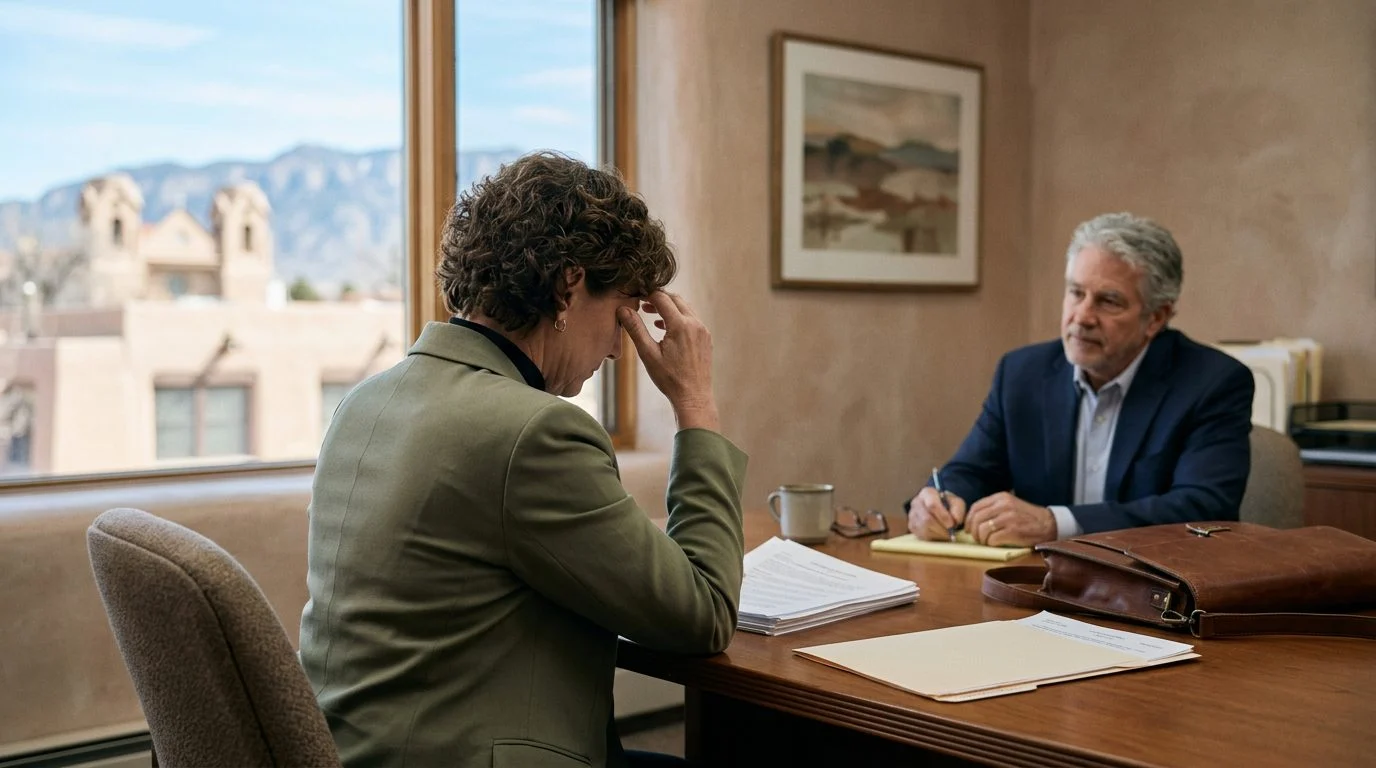
New Mexico Injury Claims | Santa Fe, Rio Rancho, Las Cruces, Albuquerque area
Emotional Distress After an Injury in New Mexico: Can You Sue?
Fear, anxiety, and sleepless nights can follow a car crash, a trucking collision, or a dangerous incident. Here is how emotional distress fits into an injury claim, and how our team can help you find out where you stand.
By Josh Wood · Published November 3, 2026
Can you sue for emotional distress in New Mexico?
Yes, in some situations. New Mexico recognizes emotional harm as part of a larger claim, such as an injury claim, a wrongful death case, or a loss of consortium claim (a claim for losing a close family relationship). Emotional harm alone is rarely the whole case.
If you are reading this after a crash or a loss, you may be trying to make sense of something you did not choose. You may also be looking for answers for someone you love. This page explains the main routes in plain terms. For a wider view, read our guide to wrongful death claims in New Mexico.
If a crash or a loss has left you with questions you did not expect, we can talk through the facts of your situation with you. Talk it through with our team — the first consultation is free, confidential, and carries no obligation.

What emotional distress means in a legal claim
Emotional distress means serious mental suffering. It can include fear, anguish, shock, or anxiety that keeps going. Being upset for a day is different from harm that changes how a person lives.
Feeling pain and proving a legal claim for that pain are two different steps. You can feel real suffering after a crash. A claim still has to fit a legal rule and show how the harm happened.
Records make the harm easier to describe. Keep notes on sleep, mood, fears, and daily changes. Ask your medical provider to record ongoing symptoms and any diagnoses. Detailed notes give a clearer picture than memory alone.
Emotional harm after a physical injury
Emotional harm often follows a physical injury. A driver or passenger who was hurt in a crash may have a claim that includes the emotional impact of that injury.
Whether a defendant owed a duty, breached it by failing to use reasonable care, and caused harm depends on the facts of each claim. Herrera v. Quality Pontiac lays out these elements.
A cause is a proximate cause when, in a natural and continuous sequence, it produces the injury. It does not have to be the only cause. The same case explains this point.
How fault is assigned depends on the facts of each case.
A person who was hurt in the crash and a person who only heard about it later usually have different paths. Which path fits depends on the facts.
Bystander claims after a crash or violent event
Watching a loved one get hurt can cause deep, lasting harm. Some people in that position ask whether they can recover for it. The answer depends on the facts: where the person was, how the event unfolded, and how close the relationship was.
Details matter later. A witness at a crash scene may remember the sounds, the timing, and what they saw first. Write those details down while they are fresh. Tell your provider about any fear, nightmares, or trouble being near roads or vehicles.
These steps do not create a claim on their own. They give a clearer record of what happened and how it affected you.
Intentional infliction of emotional distress
Some claims involve conduct done on purpose or with reckless disregard for others. These claims focus on how extreme the conduct was. Examples connected to the firm’s practice areas include a violent attack linked to poor security or a sexual assault.
Rude words or one unpleasant moment, on their own, are usually a different matter. Courts look closely at how severe the conduct was and what the person did.
When conduct goes beyond carelessness, punitive damages (money meant to punish) may come up.
Emotional distress in wrongful death cases
When a person dies because of another’s wrongful act or neglect, New Mexico law allows a claim for damages. Under the wrongful death statute, § 41-2-1, the party who would have been liable had death not occurred can be sued even though the injured person died.
§ 41-2-3 lets the jury consider the financial loss to the people entitled to the judgment, along with the circumstances of the wrongful act. The statute also sets an order for distributing the proceeds, starting with a surviving spouse: if there is a surviving spouse and no child, the spouse takes the proceeds; if there is a surviving spouse and a child or grandchild, one-half goes to the surviving spouse and the remaining one-half to the children and grandchildren.
The deadline is strict. Under NMSA 1978, § 41-2-2, the cause of action accrues as of the date of death, and every action instituted under these provisions must be brought within three years after the cause of action accrues (NMSA 1978, § 41-2-2 — three years from the date of death).
Family members may have their own claim. Thompson v. City of Albuquerque says loss of consortium damages belong to the family member. For a general look at how these cases are valued, see how wrongful death cases are valued.
Not sure what your next step is?
Talk it through with our team — the first consultation is free, confidential, and carries no obligation.
Can emotional harm be repaired, and what should you document now
Money cannot undo emotional harm. A legal claim can seek compensation for losses that follow from an injury or death.
Time limits matter. New Mexico generally allows three years for an injury to the person under § 37-1-8. Minors and incapacitated persons get more time. Under § 37-1-10, they have one year after the incapacity ends. Because these clocks run, an early review of the facts is important.
Start documenting now. Keep a simple journal of sleep, appetite, nightmares, and moments that trigger fear. Save every medical bill, visit summary, and diagnosis. Tell your treating provider about symptoms that continue.

Talk with El Gringo Law about your situation
Quick answers
How long do you have to file?
Wrongful death actions must be brought within three years after the cause of action accrues, which occurs on the date of death (NMSA § 41-2-2).
Can family members recover?
Family members may have their own loss of consortium claim, and a wrongful death claim is brought by the personal representative.
If a crash, an injury, or a death has left you with questions, you do not have to work through the legal side alone. Josh Wood, one of the firm’s lawyers, is the responsible lawyer for this page. The initial consultation is free, confidential, and carries no obligation to continue. You can reach El Gringo Law through its contact page by contact form or chat.
How we approach emotional distress claims
Plain-language answers
We explain how emotional distress may relate to your case, without legal jargon, so you know what to expect.
Careful record-keeping
We help you organize medical notes, counseling records, and other documentation that describe how the incident has affected your life.
Attention to the whole person
Emotional harm is real, even when it is not visible. We take the full impact of the incident into account.
Support from our team
Our team of lawyers and staff keeps you informed and answers your questions throughout the process.
Incidents where emotional distress often comes up
Car accidents
Serious collisions can leave lasting fear of driving, nightmares, and anxiety, alongside physical injuries.
Trucking accidents
Crashes involving large commercial vehicles can be sudden and severe, with emotional effects that continue long after the scene is cleared.
Premises liability and negligent security
Injuries on unsafe property or in places where security failed can leave people feeling unsafe in everyday life.
Wrongful death and sexual assault
Families and survivors often face grief, trauma, and loss. Our team handles these matters with care and discretion.
Start keeping a simple record
Write down when symptoms began, how they affect sleep, work, and relationships, and every appointment you attend. Clear notes can help your legal team understand the full impact of what happened.